
Pins, Patience, and Pajamas: The Hilarious Truth About Sewing with Husbands Around
Intro: Why I Wrote This Guide
The short answer is: because I have a husband and he needed ‘training’. For the long answer, read further 🙂!
I’ve been sewing for a long time. Long enough that I no longer question whether I need more fabric. I just wonder if I have enough shelf space.
But in the early days? Oh, my husband was baffled. He couldn’t understand why one person would need not one, not two, but multiple sewing machines. “Isn’t one enough?” he asked, innocently, as I rotated between machines like a one-woman factory — stitching seams on one, finishing edges on another, and firing up the embroidery unit to add a fancy little flower.
Then there was the fabric. The beautiful, carefully curated, not-to-be-touched-without-permission fabric. “Why do you need so much?” he’d ask. Or worse, “Didn’t you just buy some last week?” As if that were relevant.
Shall I mention the scissors? Without training, he never understood why cutting denim is ok, but cutting paper with my scissors is a capital crime.
I tried explaining. I gave tours of my collection. I demonstrated the difference between rayon and cotton lawn. But to him, it all looked the same — just piles of “material” and mysterious machines with buttons I silently prayed he’d never try to press, because unlike us, he does not have a built-in fear of mechanisms..
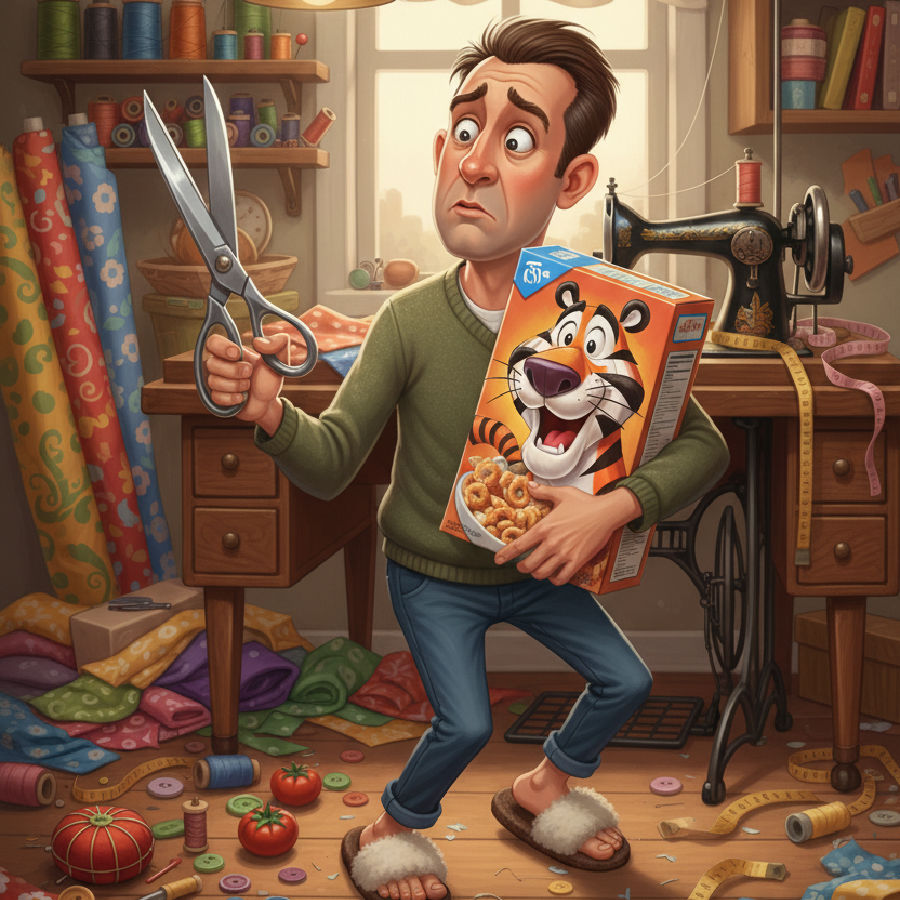
Still, over the years, something magical happened. Slowly, very slowly, he began to learn. He stopped using my fabric scissors on cardboard (we’ll come back to that incident). He even started asking useful questions — like “Are you sure you prewashed this?” and “Want me to pin the hem while you check the fit?”
And that’s when it hit me. Training a husband isn’t all that different from sewing. It takes time, patience, the occasional seam ripper, and a good sense of humor. Did I mention patience?
So, I decided to write this guide. For every sewist who has ever found a screwdriver in their button jar. For every woman who has ever tried to explain that “no, this is not a duplicate skirt pattern — it’s a different design.” And for every husband who has ever tried to be helpful… and accidentally used the good shears to open a bag of mulch.
Let’s begin, shall we?
Understanding the Husband Species
Before you can train your husband, you must first understand him. He must be observed in his natural environment. This will not only help avoid unnecessary stress (for both of you), but it can also prevent tragic incidents — such as using your quilting cotton to wipe motor oil off his hands.
Identifying Your Husband’s Natural Habitat
Contrary to popular belief, your husband’s natural habitat is not limited to the couch or the garage. He may also roam near the fridge, hover behind you while you’re trying to sew, or suddenly appear when you’re cutting fabric — especially if snacks are involved.
Pay attention to where he tends to congregate. This will help you set up sewing room boundaries later. For example, if your husband regularly invades your sewing space to look for “that screwdriver I left here,” you may need to reinforce your fabric borders.
Common Husband Behaviors in the Wild
You may observe some of the following behaviors in your domestic husband:
- Touching the rotary cutter like it’s a toy
(Followed by a mild injury and a dramatic retelling of the event to friends.) - Asking why you have three irons
(Answer: One for fabric, one for interfacing, and one for when the first two are hiding.) - Making casual comments like “You’re still working on that?”
(Yes. Because some of us don’t consider putting up a shelf and calling it a day a ‘project.’)
Learning these behaviors is key to shaping future responses. Like a seasoned wildlife expert, you don’t scold — you redirect. Gently. With cookies, if necessary.
Decoding Husband Communication Patterns
This is where things get interesting. Husbands often communicate using vague noises, slightly raised eyebrows, or oddly timed suggestions such as, “You should make a pair of curtains for the garage.”
Translation: “I noticed you’re good at sewing and I want something but I don’t want to seem like I’m asking for anything complicated.”
Other common phrases include:
- “What does this foot do?”
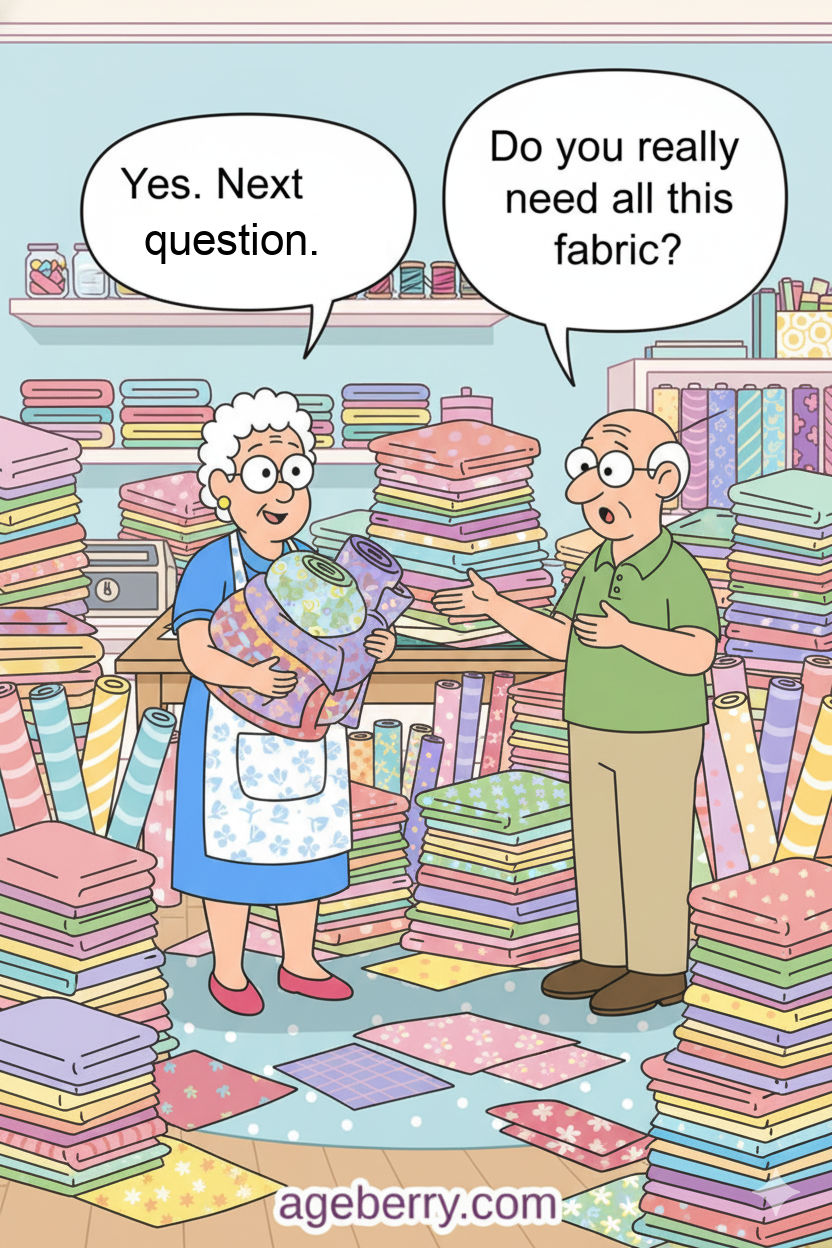
(Usually asked while holding your walking foot upside down.) - “Do you really need all this fabric?”
(Yes. Next question.) - “Is this trash or something important?”
(It’s a bobbin full of embroidery thread. It is not trash. It is a treasure.)
The key is patience. With the right cues, you can start turning these bewildered questions into helpful actions. Or at the very least, prevent him from throwing away your pattern pieces.
Sewist’s Toolkit for Husband Training
Every sewist knows you can’t make something beautiful without the right tools. The same goes for training husbands. You’ll need a special set of supplies — some borrowed from your sewing room, others from … let’s say, the deep wells of your soul. Mostly patience. A lot of patience.
Note: Some of the links on this page are affiliate links. This means I will receive a commission if you order a product through one of my links. I only recommend products I believe in and use myself.
Essential Tools: Pins, Needles, and Patience
Your first instinct might be to use a seam ripper, but trust me — that’s for fabric, not feelings. Instead, you’ll need a toolkit that includes:
- Pins, for pricking his attention when it starts wandering mid-conversation. (Metaphorically, of course.)
- Needles, because sometimes you have to gently stitch an idea into his mind more than once.
- Patience, the industrial-strength variety. This one gets used the most, especially during the “that’s not the fabric scissors, right?” phase.
And don’t forget your invisible zipper foot — not for him, for you. It helps you silently zip your mouth shut when he suggests – “just eyeball the hem.”
If your own toolkit needs a refresh (or if yours mysteriously vanished after someone borrowed it), here are a few favorites I use — and yes, I’ve had to replace them sometimes.
These Taylor Seville Magic Pins are my absolute go-to for delicate fabrics like silk. They glide smoothly, they don’t snag, and they’re easy to grip. I love them — which is why it was particularly painful when my husband used them to dig out splinters. Here’s the exact kind I use on Amazon.
For needles, I stock up on Schmetz Microtex Sharp size 80/12 by the hundred. These are perfect for precision stitching, especially on lightweight fabrics. And somehow, my husband thought they’re great for “fixing” things like backpack straps and car upholstery. So now I buy the 100-pack on purpose.


And the invisible zipper foot? That one’s mine and only mine. Well, thankfully, he hasn’t figured out how to repurpose that one yet.

Selecting the Right Thread (of Conversation)
Just like thread weight and fiber type matter in sewing, the way you talk matters when training a husband. Some situations call for sturdy polyester. Others require the softness of silk.
For example, when he asks, “Do you really need five different types of interfacing?”, you could respond with, “Do you need five different wrenches that look the same?”
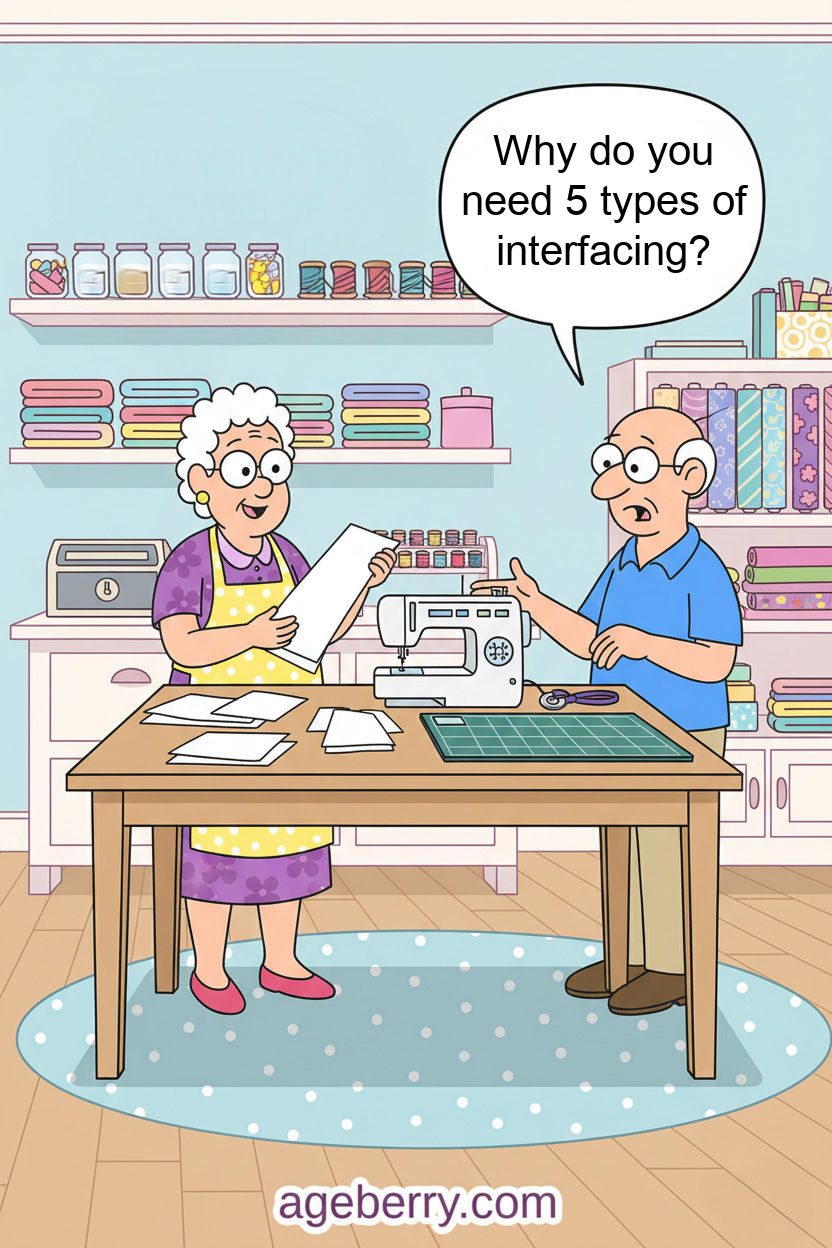
But better to go with a gentler thread: “Each type does something different. Want to see how one makes the neckline crisp?” I guarantee this will cause a prompt retreat and will end the argument.
But the goal isn’t to win the argument. It’s to sew a new stitch of understanding into his very soul. Or at least get him to stop using your fabric shears on Amazon boxes.
Speaking of interfacing… five types is actually not a lot. In fact, if you only have five, you’re probably due for a supply run. There’s lightweight fusible for soft structure, medium-weight for collars that mean business, knit interfacing for stretchy things that shouldn’t stretch that much, woven for garments that need shape but not stiffness, and non-woven for… well, everything else.
So the next time your husband asks, “Do you really need all of these?” you can confidently say, “Yes. And I might need a few more.”
If you want to see what I keep on hand (and restock sometimes), here are a few tried-and-true options:


Actually, I think I really need more …
Measuring Progress Without a Tape Measure
Progress in husband training doesn’t come with exact measurements — no handy ⅝” guides here. Instead, you’ll need to notice the subtle signs:
- He no longer places drinks on your cutting table.
- He can identify a bobbin and a spool of thread.
- He refers to “the red fabric with the tiny birds” instead of just “that stuff.”
These moments are worth celebrating. They’re the equivalent of matching up all your seams on the first try — rare, but glorious.
And remember, if he folds fabric and puts it back (even badly), praise the effort. It’s not about perfection. It’s about progress… and keeping your good scissors safe.
Setting Up the Sewing Room (and the Husband)
A well-organized sewing space is a beautiful thing. A well-trained husband who knows where he’s allowed to stand while you’re tracing a pattern? That’s practically art. Setting up your sewing room isn’t just about workflow. It’s about survival — for your tools and your relationship.
Designating Safe Zones for Scissors
First rule of scissors club: do not use the fabric scissors on anything that isn’t fabric.
This may seem obvious to you, but to husbands, scissors are apparently all-purpose tools meant for opening cereal bags, trimming wires, or — I kid you not — cutting zip ties off car parts.
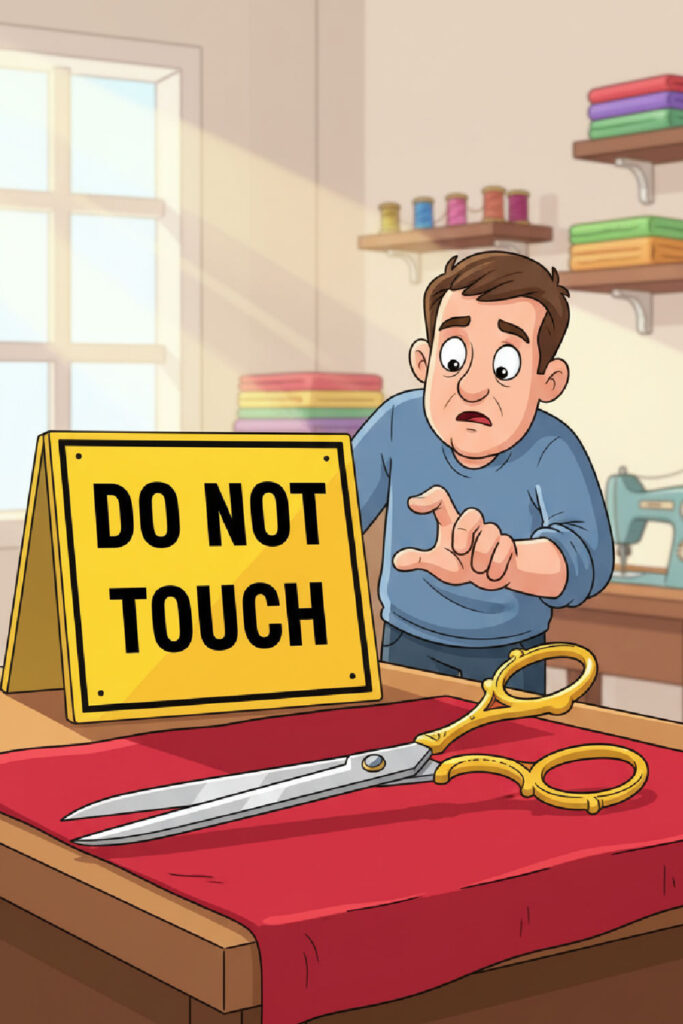
You need a clear system. Something visual. Label your good shears. Put them on a pedestal. Wrap them in velvet and add a sign that says “These scissors are sharper than my tone when you misuse them.”
Even better, create a “husband scissors” area. Buy a pair just for him — the kind that can cut through cardboard, mystery garage gunk, and maybe his own questionable decision-making (ha-ha).
It’s a small gesture. But it could save your marriage.
And if you’re wondering which shears deserve the velvet treatment, these are my all-time favorites. They cut like a dream (the 9” model I had for 6 or 7 years), feel like they belong in a museum, and make the most satisfying snick sound — you’ll want to guard them like state secrets.

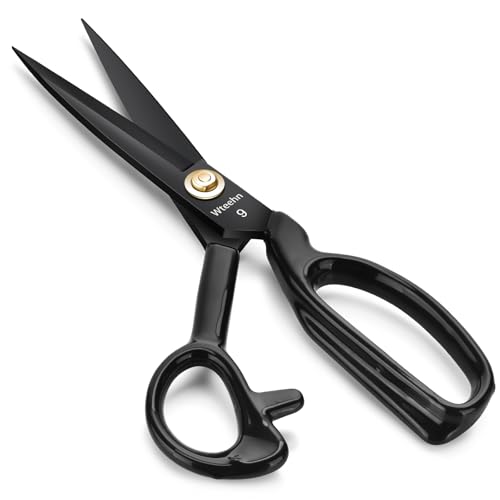
Just don’t let your husband even look at them too long. Curiosity dulls blades. Probably.
Establishing Boundaries: Fabric Stash vs. Husband Space
Have you ever caught your husband casually sitting on your folded fabric stash?
Let’s get one thing straight: your stash is not extra couch cushioning. It is not “just cloth.” It is a curated, emotionally significant, financially substantial collection of possibilities.
The solution? Create zones.
- Your cutting table? Fabric-only territory.
- Your drawers? Off-limits unless supervised.
- That one chair where you drape half-finished projects? Sacred.
Then, give him his own corner. Put a comfy chair near your sewing space if he insists on “hanging out.” Maybe add a puzzle book or a snack. Something quiet. Something that doesn’t require him to lean across your traced pattern to find the remote.
And while you’re at it, consider investing in a rolling cart — like this one I use. It can double as a husband buffer zone.

Stock the top shelf with his scissors — the ones he can use for cardboard, duct tape, and whatever else he feels compelled to cut (just not fabric). Toss in extra pins and pattern weights too. Use the middle for snacks he’s allowed to touch, and the bottom for the items he always loses: tape measures, flashlights, phone chargers, and possibly his will to organize things properly.
Why does this help? Because giving him his own designated cart trains him to check there first before asking, “Where’s that pokey thing again?” It keeps your supplies safe, your scissors unbent, and your sewing space one step closer to harmonious.
And when he wheels it over proudly and offers YOU the right tool (without touching your good shears), you’ll know: the system works.
Training Techniques: Stitching Good Habits
Now that your sewing space is set up and your husband is no longer treating your stash like it’s a nap mat, it’s time to start shaping some actual behaviors. Just like teaching someone how to sew a straight line, it takes repetition, encouragement, and the occasional cookie bribe.
Positive Reinforcement With Homemade Cookies
You’ve probably noticed that husbands respond well to snacks.
So when he remembers to ask before using your good fabric, or correctly identifies the “interfacing” drawer without calling it “the crunchy stuff,” reward that behavior.
Homemade cookies are ideal. They’re soft, sweet, and smell like victory. You don’t have to say much. Just casually hand one over with a warm, “Good job, babe. You didn’t toss my traced pattern today.”
Other acceptable rewards include:
- A second cookie
- Not making that face when he walks into the room with a suspicious cardboard box
- A heartfelt “thank you” when he picks up a pin without stepping on it first
Reinforcement works best when it’s quick and specific. So, don’t just say “Thanks.” Say, “Thanks for asking if I needed the hem pressed. That was really helpful.” Then hand him a cookie and watch him beam like he just fixed the dishwasher.
The Art of Gentle Reminders (and Seam Rippers)
Sometimes, things go off-pattern.
Like when he “cleans up” your sewing table and accidentally throws away a marked-up muslin. Or when he volunteers to “wind some bobbins” and creates a thread monster that looks like it escaped from a sci-fi movie.
This is where the gentle reminder comes in.
Think of it like using a seam ripper: you’re not angry. You’re just undoing a tiny mistake so things can go smoother next time.
A few options:
- “Hey love, I appreciate the tidying, but next time just ask before moving anything with pattern pieces on top.”
- “I love that you want to help — let me show you how to wind a bobbin.”
The key is kindness with a hint of clarity. You’re not scolding. You’re teaching. Because every good habit starts with a small correction and a big sigh of relief that your serger blades survived the encounter.
And if all else fails? Take a break, eat a cookie, and remember — even seam rippers have their limits.
Advanced Husband Handling Strategies
So now your husband knows what a bobbin is. He can identify the fabric scissors. He even puts your pins back in the pin cushion, not into the nearest armrest. Congratulations. You’re ready for advanced techniques — the kind that involve real-life problem solving, emotional navigation… and possibly, the TV remote.
Dealing With Lost Buttons (and Lost Husbands)
Lost buttons are an everyday sewing problem. But when your husband is the one who loses them — or worse, brings you his shirts like an emergency room patient — things get interesting.
He’ll say something like, “It just fell off,” or “It’s been gone for a while… I think I put it somewhere safe.” (Translation: It’s in the lint trap, the garage, or another dimension.)
The trick here is to stay calm. You are the button whisperer now.
Instead of launching into a “Why didn’t you say something before laundry day?” speech, try this: “Let’s take a look. I might have a button that matches — and if not, guess who’s getting a fashionable contrast button?”
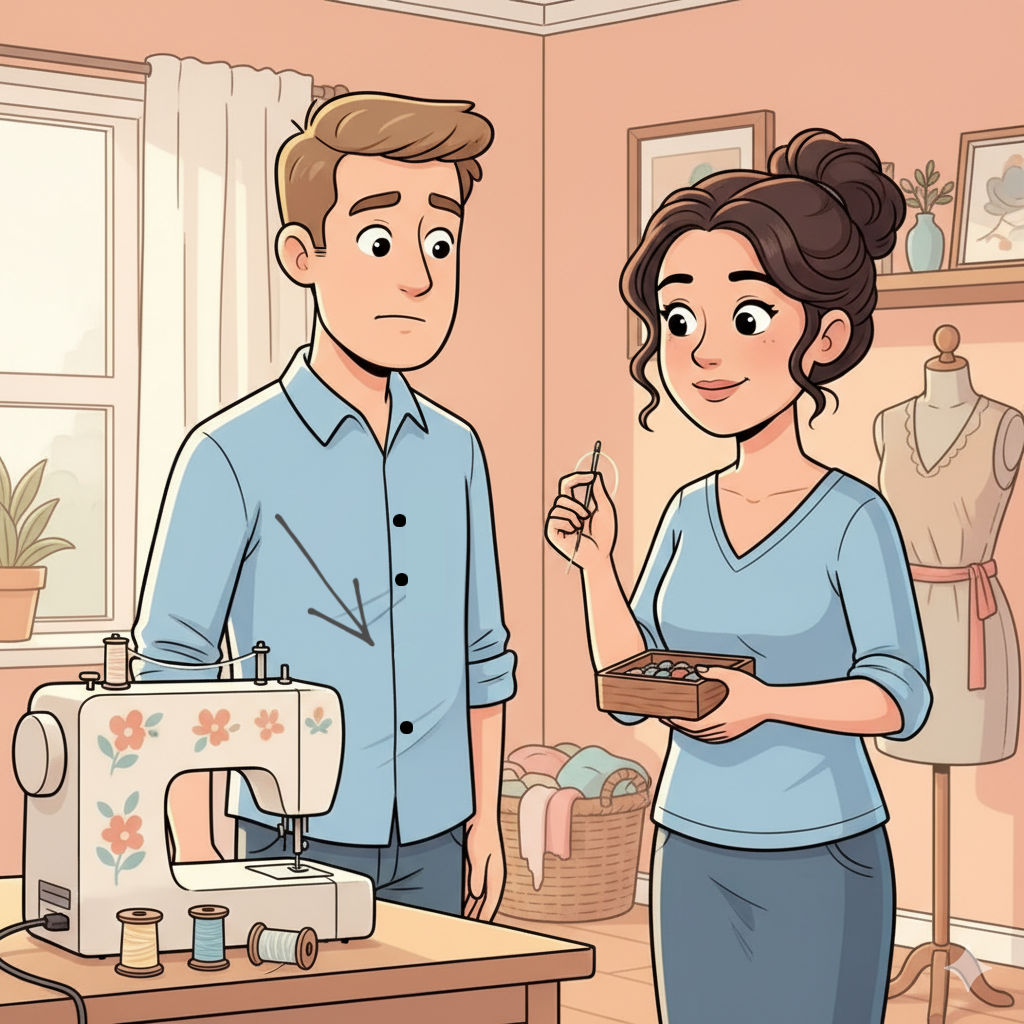
Lost buttons are annoying, but they’re also an opportunity. A chance to make his wardrobe slightly more stylish without him noticing. And if he starts paying attention to your creative solutions, he just might begin to appreciate the finer points of interfacing.
As for lost husbands — the kind who disappear when it’s time to help hold a quilt or carry your 44-pound fabric haul from the car? That’s a separate issue. Consider attaching a tracking device to the TV remote.
Negotiating Remote Control vs. Rotary Cutter Time
There comes a moment in every relationship where both parties want control: one over the remote, the other over the rotary cutter. Neither should be wielded carelessly.
Scenario: He wants to watch a suspense thriller with explosions. You want to cut your quilt pieces in peace.
Solution: Negotiation.
Here are a few proven strategies:
- Rotary cutter hour = one episode of his show later. (He doesn’t have to know you’ll be cutting during his show too.)
- Noise-canceling headphones for both parties. Bonus: You won’t hear him say, “Isn’t that the same fabric as the last one?”
- Let him pick dinner if you get the table. He gets pizza. You get a clean, flat surface.
And if the tension builds? Just smile and say, “Remember who hems your pants.” It’s not a threat. It’s a friendly reminder of your power. There are also other subtle “reminders”, I just can’t remember them at the moment …
Sewing Projects He’ll Actually Help With
At some point, you realize he’s not just hanging around the sewing room for snacks and admiration. He wants to help. Or he’s at least willing to help — if there’s something in it for him. This is where strategic project planning comes in. Find the overlap between your skills and his motivation, and magic can happen.
Bribery: Custom Pajamas for Chores
Let’s not pretend we’re above bribery. If sewing has taught us anything, it’s that a well-timed offer of comfort can move mountains. Or at least convince someone to vacuum.
Enter: custom pajamas.
There is no faster way to a husband’s cooperation than the promise of flannel pants that actually fit. Especially if they come with deep pockets and fabric he picked himself — even if it’s covered in moose.
The setup is simple:
- “I’ll make you those cozy pajama pants you wanted.”
- Pause for effect.
- “Right after the dishwasher’s empty and the boxes in the garage are labeled.”
Some may call it manipulation. We call it creative project management.
✅ Serious tutorial: How to Make a Pajama Shorts Pattern (XS–XXL) Using Your Own Measurements
Teamwork on Quilt Sandwiches
There’s nothing quite like watching a man attempt to smooth out a quilt backing with the intensity of a bomb squad technician. This is the moment you realize: he’s finally part of the process.
Quilt sandwiching is one of the few sewing tasks that truly benefits from extra hands — especially big ones that can hold down corners without complaining.
Give him a role:
- Chief wrinkle smoother
- Tape dispenser king
- Pin-passer and snack supervisor
Will he do it your way? No. Will he accidentally step on the quilt top while adjusting it? Probably. But will it save your knees and hands? Absolutely.
And the best part? When the quilt’s done, he’ll proudly say, “We made this.” And he’ll mean it — even if his biggest contribution was holding the dog back during basting. But he doesn’t need to know that.
Celebrating Success: When Husbands Go Off-Pattern
There comes a time when you look at your husband and think… Did he just remember what selvage means? It’s in these moments, between a correctly folded fat quarter and a rescued dropped pin, that you realize something wonderful: he’s gone completely off-pattern — in the best way.
Unexpected Husband Achievements
Some wins are obvious. Like the day he stops calling your serger “that noisy thread blender.”
Others are more subtle but equally thrilling:
- He brings you a cup of tea without placing it near the fabric.
- He starts recognizing fabric types. “Is this knit? It’s got that stretchy feel, right?”
- He asks if the interfacing goes on the wrong side before ironing it down.
These are not just cute moments. These are badges of honor. And then there are the big ones — the kind that make you pause mid-stitch:
- He fixed the thread nest without panicking.
- He organized your bobbins by color and acted like it was the most logical thing in the world.
- He told someone else, “No, you can’t cut paper with those scissors.”
Celebrate every one of them. These are the husband equivalents of lining up plaid at the side seams.
Might I suggest a proper award? Something he can wear proudly while pretending he doesn’t love helping with your sewing projects.
These socks say it all: “Yes! I really do need all these sewing machines” socks. Bright, bold, and suspiciously accurate — just like your favorite thread.

Documenting Progress With Before-and-After Photos
You probably have photos of your sewing projects. Now it’s time to add one more album: Husband in Training.
Start with the “Before” shots:
- Using tailor’s chalk like a crayon and drawing on the table instead of the fabric.
- Using your quilting ruler to swat a fly (don’t laugh, this happened!)
- Standing in your stash closet asking, “Is all this fabric?”
And then the glorious “After” moments:
- Pinning a hem with care and correct spacing
- Reading the pattern instructions before asking questions
- Referring to thread weight like it’s second nature
If he asks why you’re taking his photo mid-task, just tell him it’s for the archive. Someday, you’ll both look back and laugh. Or at least you will.
Troubleshooting Common Husband Malfunctions
Even the most attentive, well-behaved husband will occasionally short-circuit. It’s not a flaw — it’s just part of the system. The good news? You already know how to handle tangled thread, skipped stitches, and tension issues. This is really no different.
Fixing Tangled Threads (and Misunderstandings)
Sometimes, wires get crossed. He thinks he’s being helpful. You think he’s reorganizing your entire sewing cabinet based on absolutely no system whatsoever.
Or maybe he said something like, “It’s just fabric,” and now you’re googling divorce attorneys between serger passes.
So, take a step back — just like you would with a jammed bobbin case.
Try this:
- Take a breath.
- Rewind (the conversation, not the bobbin… unless it’s both).
- Gently re-thread the situation with clearer communication.
A calm “Hey, I know you were trying to help, but I actually had a system” goes much further than a dramatic “You ruined everything!”
And if emotions run high, walk it off. Sew a few seams. Rip out a bad one for therapeutic effect. Then, when you’re both ready, re-engage with a light touch and maybe a cookie.
✅ Related tutorial: Master the Seam Ripper
Emergency Repairs for Broken Promises
We’ve all heard it:
- “I’ll hang the shelves this weekend.”
- “I’ll help you photograph the finished projects.”
- “I’ll definitely not leave my coffee on your cutting mat again.”
And yet… here we are.
Broken promises don’t always mean bad intentions. Sometimes they’re just like skipped stitches — the machine was moving, but nothing really happened.
So what’s a sewist to do?
First, assess the damage. Is it a minor missed task, or a full-blown “my finished dress is now stained with salsa” situation?
Then, choose your repair strategy:
- For small slips, a gentle nudge: “Hey, you mentioned helping me baste the quilt today… should I cue up the fabric or the guilt?”
- For repeat offenses, schedule things in writing. Husbands, like some sewing machines, function better with reminders and clear instructions.
And if he follows through next time? Reward accordingly. (See: cookies, admiration, not sighing loudly while he fumbles with the level.)
The truth is, even the best sewing machine needs an occasional adjustment. Even the most supportive partner has occasional thread snarls. What matters is the willingness to re-thread, restitch, and try again.
Graduation Day: Awarding the ‘Trained Husband’ Badge
If you’ve made it this far — and he still knows the difference between fusible interfacing and freezer paper — congratulations. You’ve reached a moment many sewists only dream of: the trained husband milestone.
Now, is he perfect? Of course not. Neither is your topstitching on stretch velvet. But the man just asked if you wanted him to press your seam allowances open before you even said anything. That deserves a standing ovation. Or at least a commemorative badge.
He’s graduated.
Not from Sewing School — let’s not get carried away — but from a custom-designed, emotionally stitched curriculum of Fabric Respect, Bobbin Diplomacy, and Rotary Cutter Awareness.
- He knows where the good scissors are (and doesn’t touch them).
- He knows to ask before using your cutting mat as a dinner tray.
- He may still call it “your sewing stuff,” but now he says it with reverence.
So what’s next?
- Maybe he becomes your official fabric-hauler at the quilt store.
- Maybe he holds your quilt layers with the precision of a technician.
- Maybe he just brings you a snack while you sew and quietly backs away.
Whatever form it takes, you now have a partner who gets it — at least enough not to sit on your traced pattern pieces.
So go ahead. Make him a badge. Embroidered, of course. Something classy, like “Level 1: Bobbin Winder, Fabric Finder.” You’ve both earned it.
✅ Related tutorial: What Can You Do With An Embroidery Machine?
Bonus Skillset: Husband-Powered Renovations
By this point, you’ve trained him to identify scissors by purpose, respect the sanctity of your fabric collection, accept that every piece of fabric has a purpose — even if you forgot what it was, and maybe even wind a bobbin. Now it’s time to deploy his final boss-level skill: assembly and installation.
Because here’s the truth — behind every beautifully organized sewing room is a husband who thought he was just going to hang one shelf.
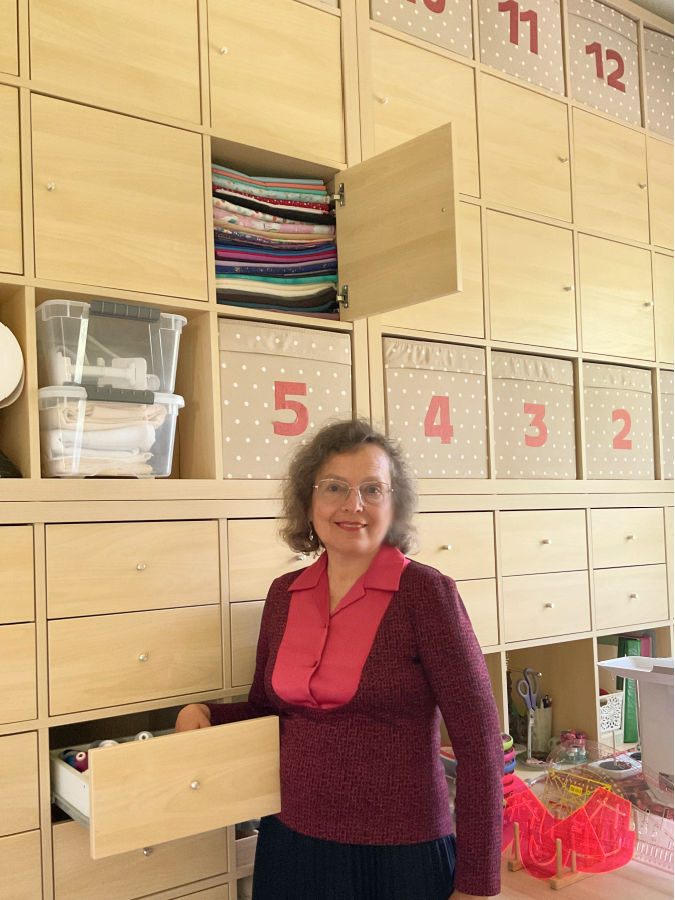
Mine? He built the entire wall unit. I’m not exaggerating. From bare walls to perfectly cubed storage, drawer after drawer, bin after bin — all carefully assembled, leveled, and installed by a man who once asked me if interfacing was “that weird white napkin stuff.”
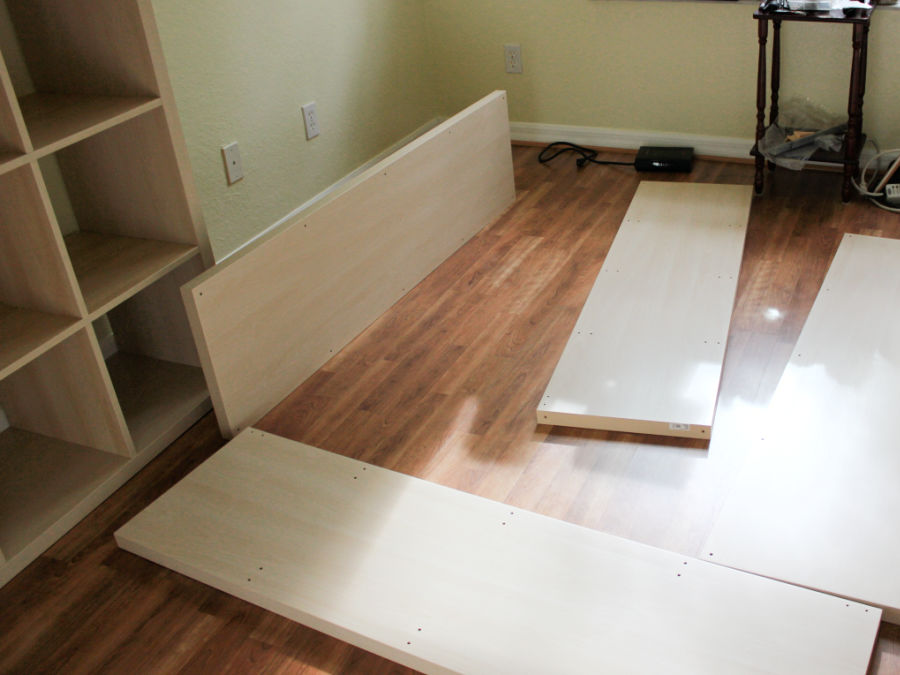
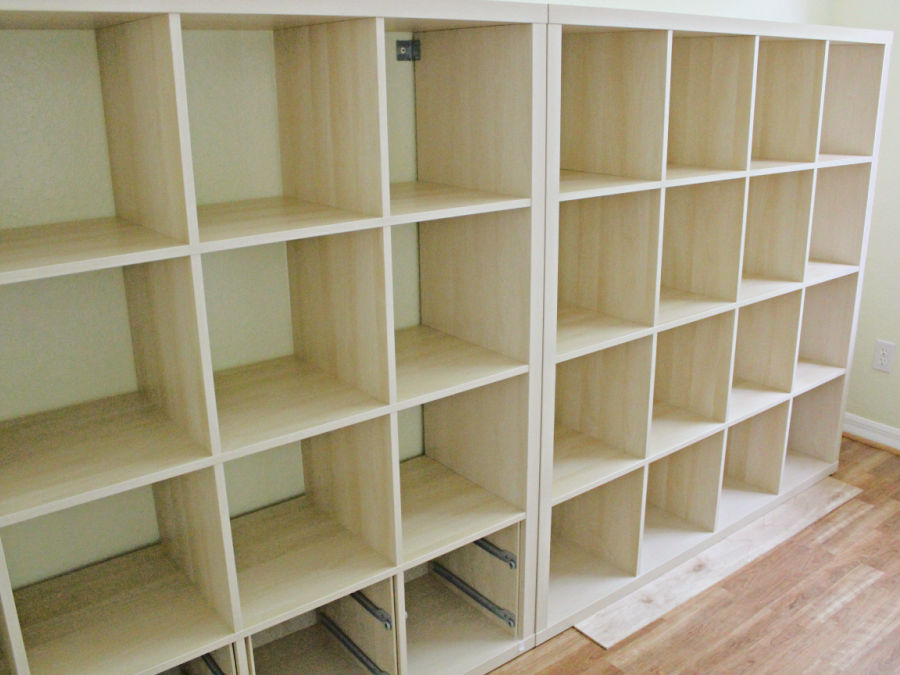
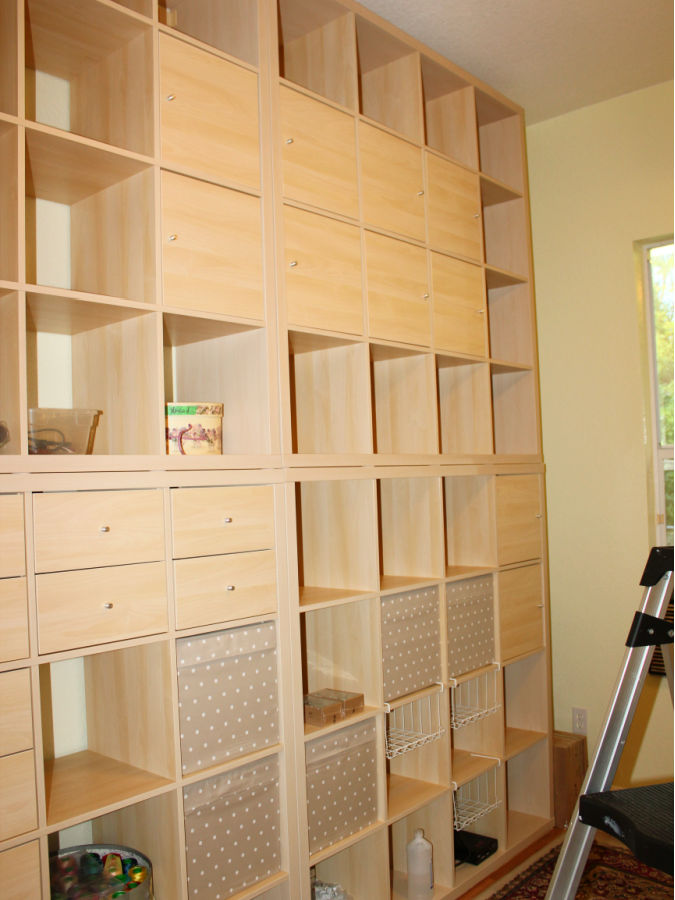
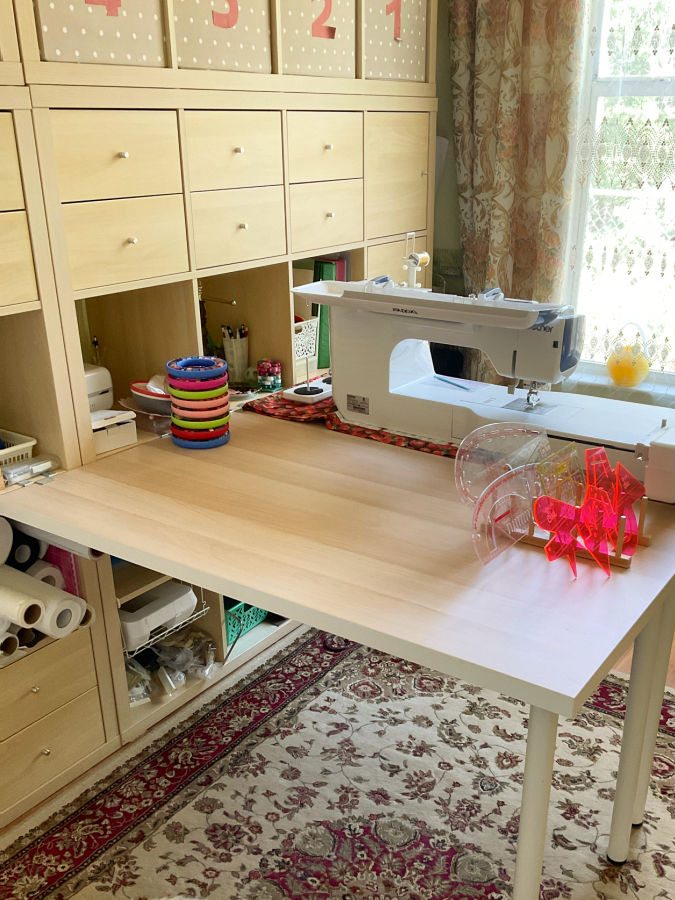
The process had all the drama of a quilt show: pieces everywhere, a little bit of arguing over measurements, and lots of stepping back to say “Wait, is this upside down?” But he did it.
✅ Related but serious tutorials:
IKEA Sewing Room Ideas for small spaces
Organizing a Craft Room with IKEA Kallax: Styling, Storage, and Desk Hack
So if you’re designing your sewing space, this is your moment. Get those IKEA boxes ready. Hand him the drill. Smile sweetly and say, “You know what would look so good here?”
Let him do the building. You can do the organizing. And later, when you’re filling drawers with thread sorted by color and weight, you’ll know deep down: he may blank on what a dart or a gusset is, but he gave those shelves a level of love no hardware store could supply.
Bonus: Real Projects for Real Husbands
If you’re now feeling inspired to sew your way to household harmony, I’ve got just the thing. Over the years, I’ve stitched up more than a few practical pieces for my husband — and for my daughter’s husband, too. You’ll find tutorials for things they actually wear, tear, and proudly request again (sometimes with a little prompting).
Here are a few real-life, husband-approved projects you can try:
- How to Easily Hem Jeans at Home: A Beginner-Friendly Step-by-Step Tutorial — because he finally found a pair he likes, and of course they’re two inches too long.
- How To Easily Hem Pants Without Sewing | New Method — for weddings, work, and the occasional “I swear this is the last-minute event” panic.
- Darning With A Sewing Machine: How To Easily Repair Holes In Your Clothes — because he’ll never throw them away, and now you don’t have to either.
- How to Hem Jeans with the Original Hem — for when he wants them shorter but still insists they “look exactly the same.” And they can. You don’t even have to tell him how much easier it was than he thought.
Each project is also beginner-friendly, spouse-approved, and comes with clear steps — no eye-rolls required. Give them a try, and you might just earn your own badge: Domestic Stitch Wizard.
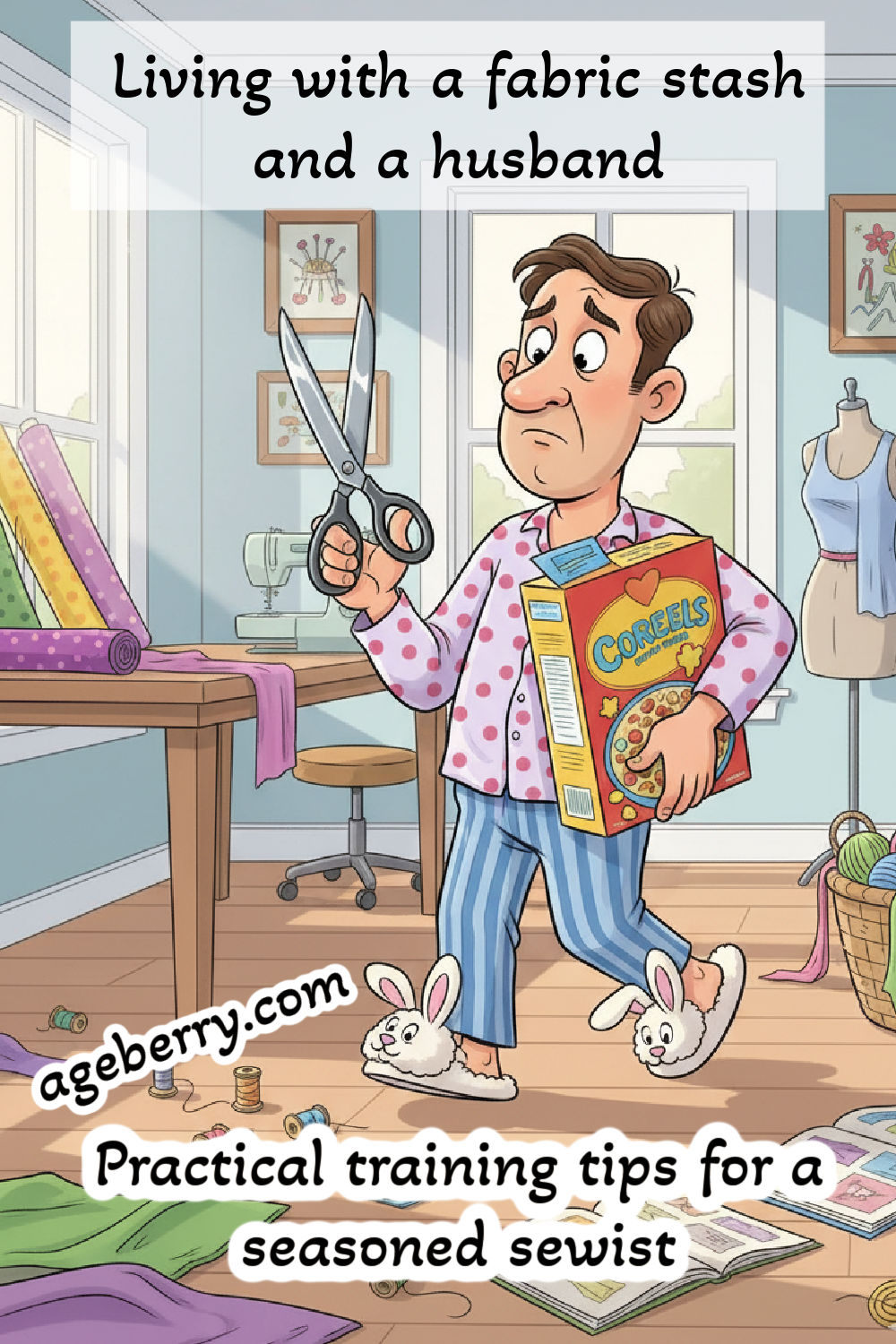
Had a little laugh? Go ahead and save this pin on your sewing board — you’ll want it handy the next time he “borrows” your scissors for something unholy. And follow me on Pinterest for more sewing room stories, how-tos, and a healthy dose of humor.

latest posts
- Knit Presser Foot: How It Works, How to Use It, and My Sewing Tests
- How to Sew Neat Mitered Corners at Acute Angles
- Sewing Machine Needle Organization: A Clever System I Tried
- DIY Car Armrest Organizer: Sewing Tutorial
- Easy DIY Potholder Sewing Tutorial: Better Shape, Better Grip, Smart New Design
- How to Buy a Sewing Machine (Even If You Already Have 10)
- 23 Kitchen Items That Belong in Your Sewing Room
- What Is a Sewing Machine Piping Foot And How to Use It
- Fixing Sewing Mistakes: Repair an Accidental Cut in Fabric
Or, easiest of all, buy a house with your OWN ROOM! He has his ‘man cave’; you deserve a ‘she shack!’
That is an excellent idea, and my husband fully supported me having my own sewing room. After all, it is VITAL for the good of the family 😀!