
23 Kitchen Items That Belong in Your Sewing Room
Some of the very useful things in my sewing room were never made for sewing at all.
They came from the kitchen.
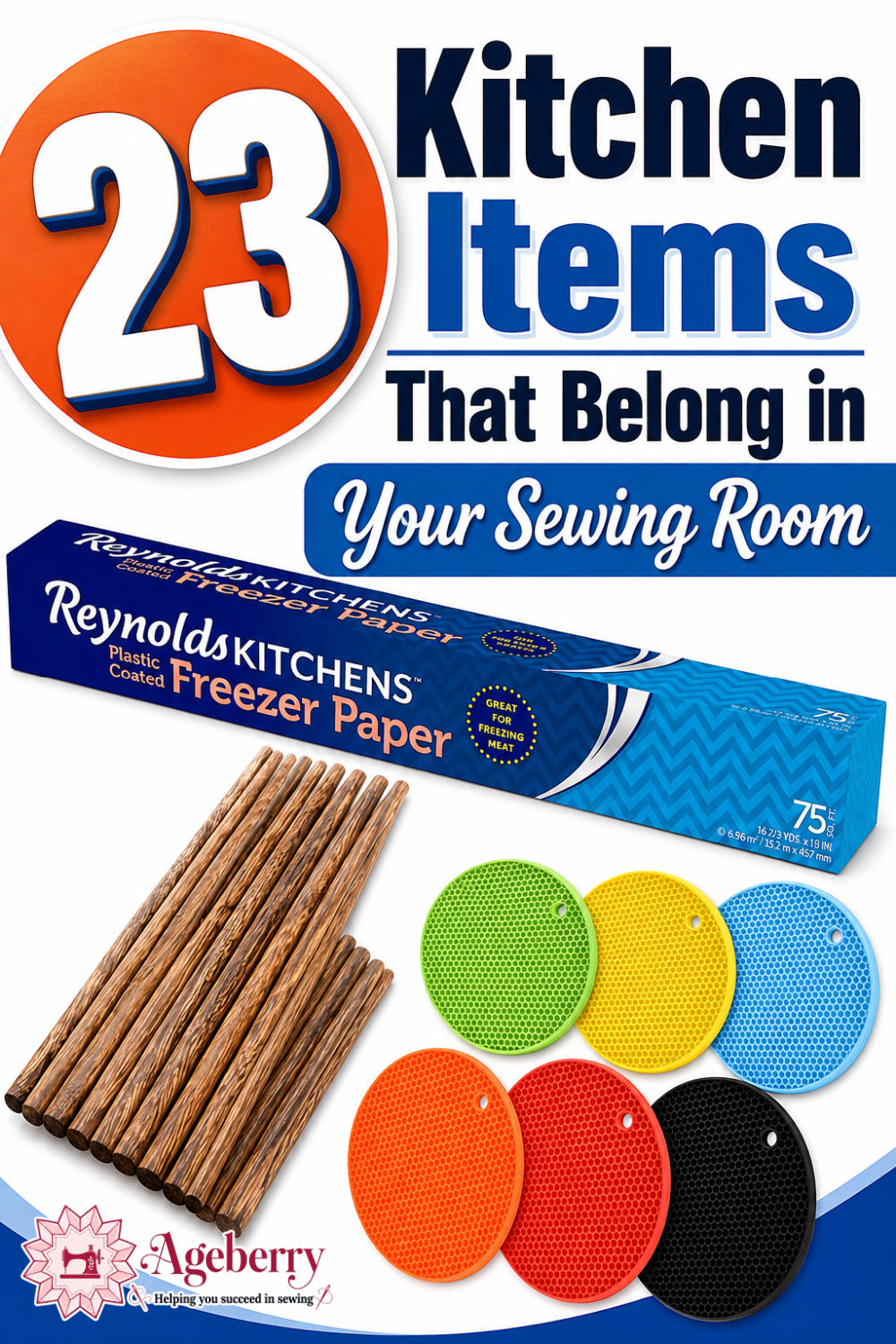
A chopstick? Sewing tool. An ice cube tray? Notions organizer. A dinner plate? Curve template. And that roll of non-slip shelf liner may finally stop your sewing machine foot pedal from traveling across the floor.
The best part? You may already have all of these things at home. And if you don’t, all of them are really cheap!
Prefer to read without ads?
I created a PDF version of this guide for anyone who likes to keep sewing guides saved, printed, or easy to read without ads. It includes the same helpful information in a simple format you can download and use whenever you need it.
The PDF is available in my shop for a small fee. It’s a nice option if you want to support my work and keep this tutorial close to your sewing machine.
So before you buy another specialty sewing gadget, take a look through your kitchen drawers and cabinets. You might be surprised by how many ordinary kitchen items can do a second job in the sewing room.
Of course, I’m not suggesting you grab the greasy pastry brush beside the stove and start brushing your fabric with it. Anything that will touch fabric should be clean. And for inexpensive items, I usually prefer to give them a permanent new home in the sewing room.
Once you see how useful some of these things are, there is a good chance they won’t be going back to the kitchen anyway.
1. Chopsticks
If you have a lonely chopstick left over from takeout, congratulations: you may already own a very useful sewing tool.
A smooth wooden chopstick is excellent for pushing out corners after you turn a project right side out. I use this kind of tool for collars, bag corners, stuffed toys, fabric baskets, and anything else where my fingers are simply too large to get into the corner.
It is also handy for pushing stuffing into narrow places such as bunny ears, doll arms, little tails, or other small stuffed parts.
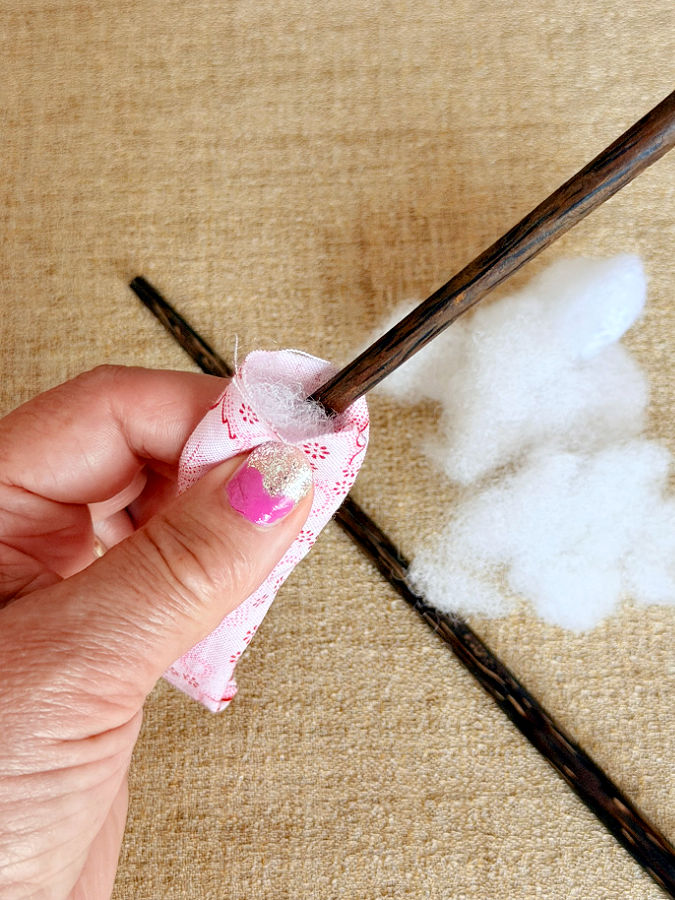
The important word here is smooth. You want to shape the corner, not stab your way through it and create an entirely new sewing problem.
And yes, you can buy an official sewing point turner. But if a chopstick does the job perfectly well, and you already have it, I see no reason to hurt its feelings by telling it that it belongs beside the soy sauce.
2. Drinking Straws
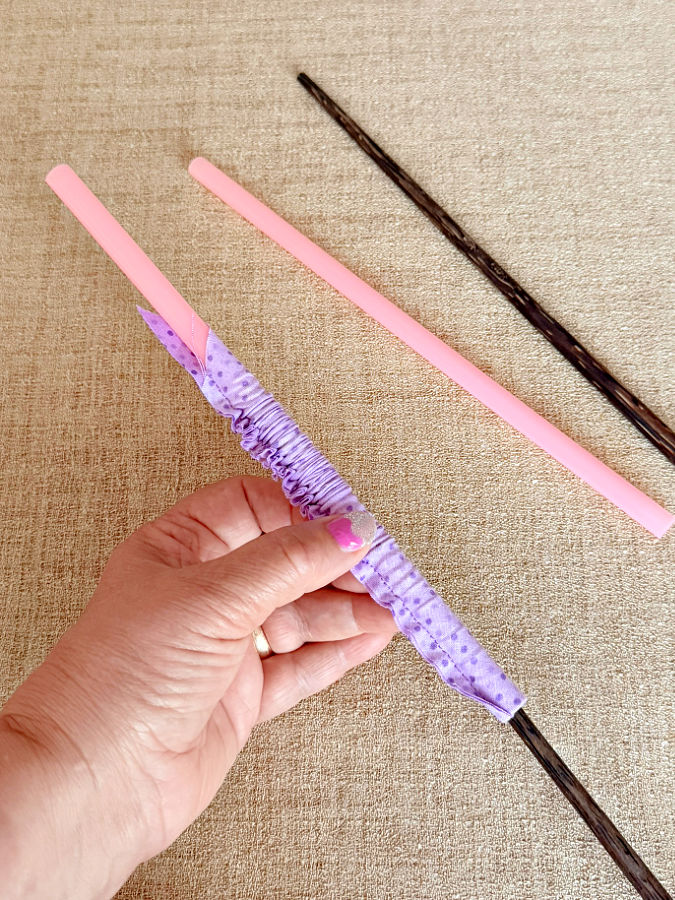
A drinking straw does not look like much of a sewing tool, but pair it with a narrow stick and suddenly it has a very respectable second career.
It is especially useful for turning narrow fabric tubes:
- spaghetti straps
- thin fabric ties
- narrow loops
- tiny belts
- doll clothing straps
One common method is to place the fabric tube over or inside the straw, then use a chopstick, skewer, or another narrow blunt tool to push the fabric through.
✅ Related tutorial: 30 Sewing Hacks That Turn Ordinary Items into Useful Sewing Tools
Note: Some of the links on this page are affiliate links. This means I will receive a commission if you order a product through one of my links. I only recommend products I believe in and use myself.
3. Bamboo Skewers
Bamboo skewers are the chopstick’s thinner, pointier relatives.
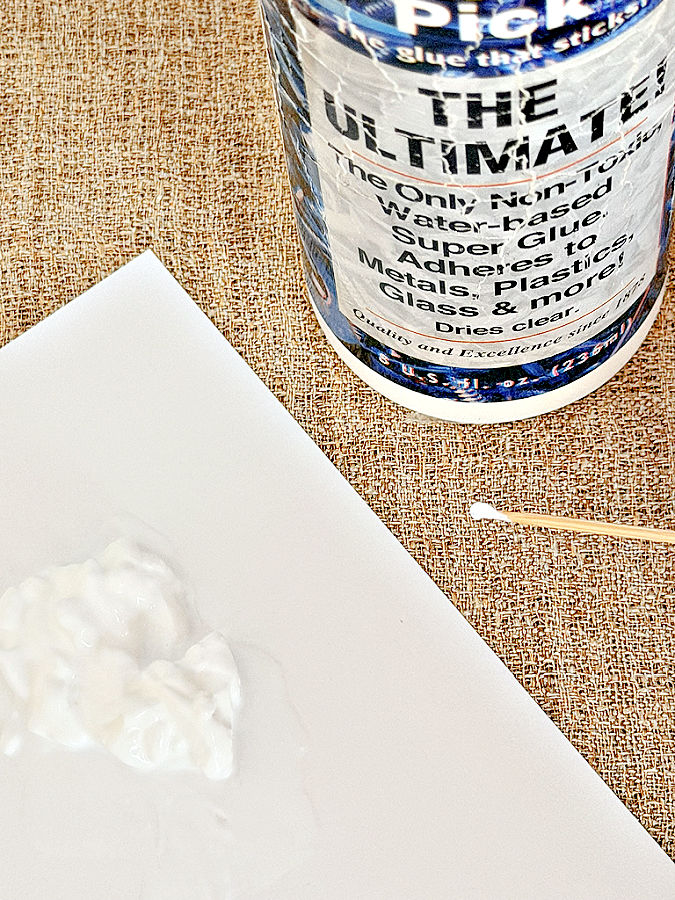
They are useful when you need to reach into a much smaller space. I may use them for positioning tiny seam allowances, working stuffing into narrow areas, moving small pieces into place, or applying a very small amount of fabric glue.
✅ Related tutorial: The Best Fabric Glue Options For All Your Sewing Projects
But there is one problem: that sharp point.
A skewer can go through fabric much faster than you would like, so be careful. Or simply cut the very sharp tip (not with your fabric scissors!!).
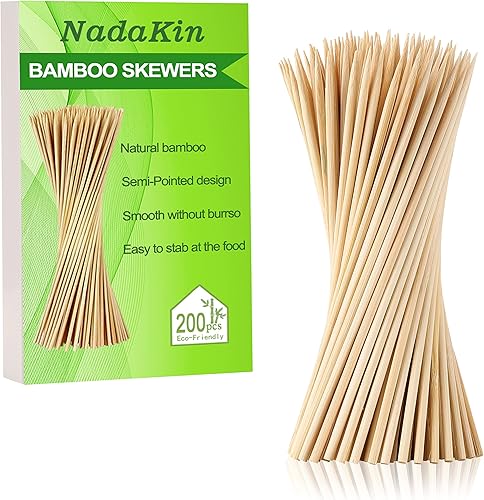
Keep several around because once you start using them, they have a strange tendency to disappear under fabric, patterns, and whatever else is currently covering the sewing table.
You know what else these are good for ? The grill! (my husband made me write this, sorry).
4. A Dull Butter Knife
Before anyone gets nervous: I am not suggesting that you cut fabric with a butter knife.
A smooth, dull butter knife can be useful for pressing and creasing.
Run the smooth edge along a folded piece of fabric and you can create a temporary crease without turning on the iron.
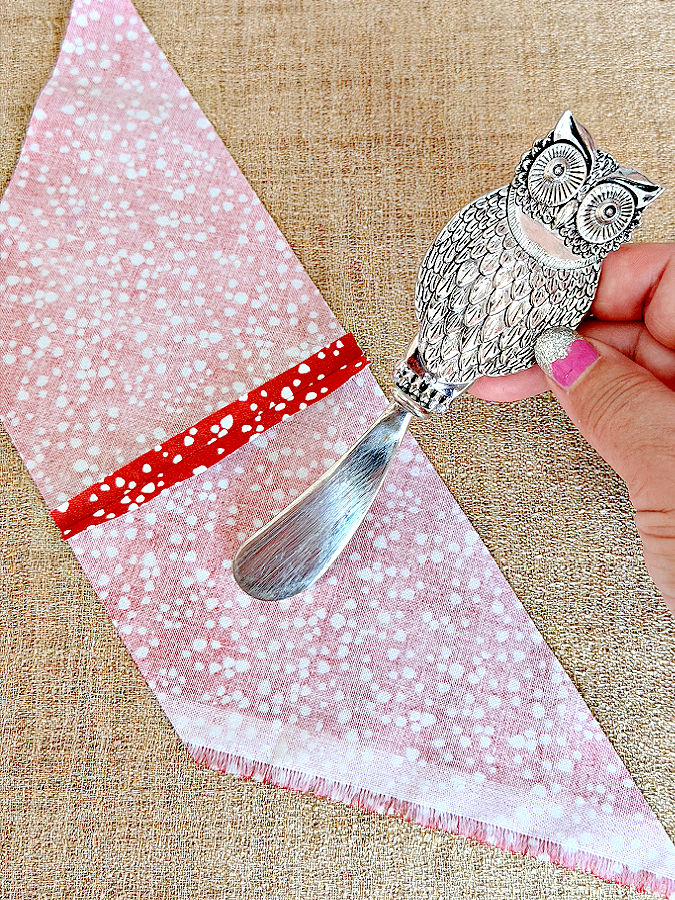
It can also help flatten seam allowances, press folds into small pieces, or push out a broad corner after turning.
This can be especially useful when you are working on something small and getting up to use the iron feels wildly disproportionate to the amount of pressing required.
Choose a knife with a smooth, rounded edge—not a serrated one—and, preferably, give it a permanent job in the sewing room.
Otherwise, someday someone will be buttering toast with your seam-pressing tool, and that seems like an unnecessary complication for everyone involved.
✅ Related tutorial: 17 Fantastic Sewing Tools And Notions To Boost Your Creativity
5. A Small Kitchen Funnel
If you sew anything that needs filling, get yourself a funnel. You know, the kind you get in a dollar store, used to be three for $1.
Actually, steal one from the kitchen first.
A small funnel makes it much easier to fill:
- pincushions
- pattern weights
- bean bags
- sachets
- rice heating pads
- weighted toys
- small pillows
It works especially well with loose fillings – rice, poly pellets, crushed walnut shells, beads, or dried lavender.
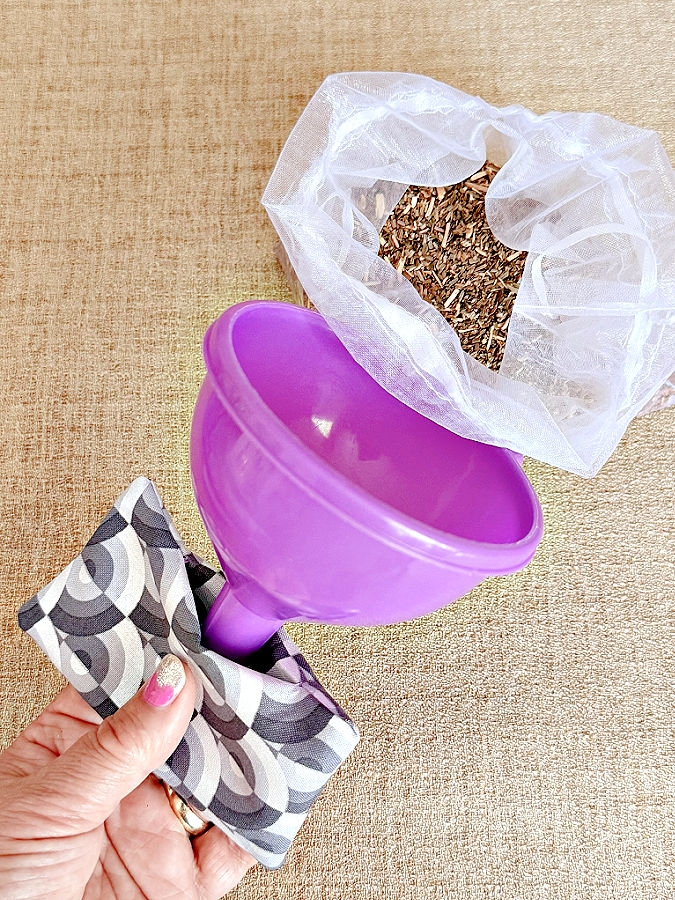
Without a funnel, filling a tiny opening usually involves pouring very carefully, missing anyway, and then spending the next ten minutes picking little pieces out of the carpet.
With a funnel, most of the filling ends up where you intended it to go. A revolutionary concept.
I like having more than one size because a funnel that works beautifully for rice may be completely useless for larger pellets or chunky filling.
And this is definitely one kitchen item I would dedicate to sewing permanently. Once a funnel has spent its afternoon inside a bag of crushed walnut shells, I probably don’t need it helping with dinner.
✅ Related tutorial: Create Your Own Yo-yo Christmas Tree: Step-by-step Tutorial
6. Plates, Bowls, Glasses, and Mugs
Your kitchen cabinets are basically full of circle templates.
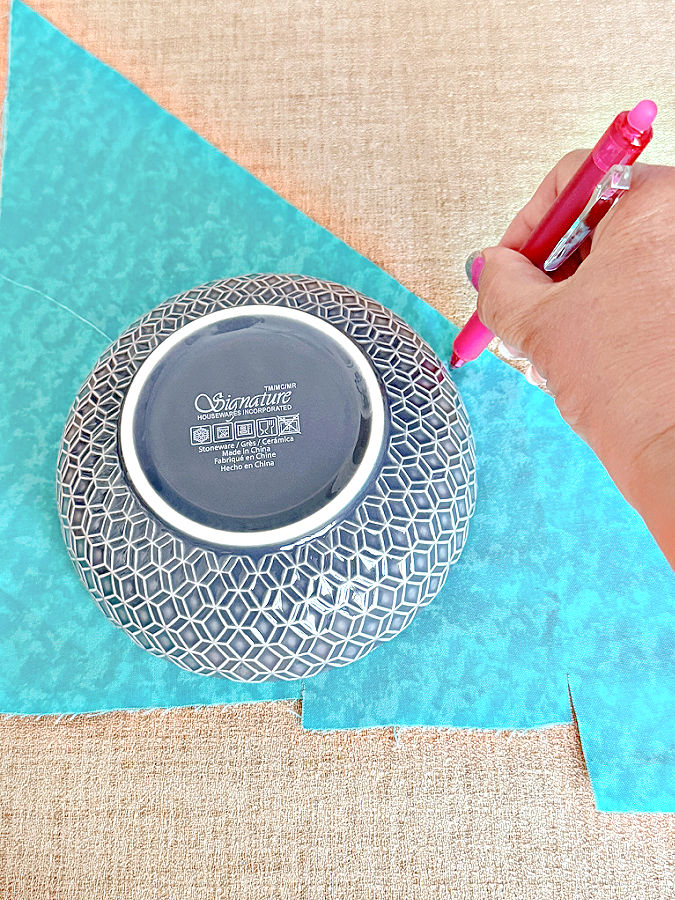
Dinner plates are great for larger curves, bowls give you even more size options, and glasses or mugs work when you need something smaller. Between all of them, you can usually find a curve that is pretty close to what you need.
Use them to:
- draw circles
- round bag corners
- create rounded pockets
- make appliqué templates
- draw scallops
- shape bag flaps
- make yo-yos
Just place the plate, bowl, or mug where you want the curve and trace around the edge.
✅ Related tutorial: How to Make Fabric Yo-Yos: A Step-by-Step Guide
7. Cookie Cutters
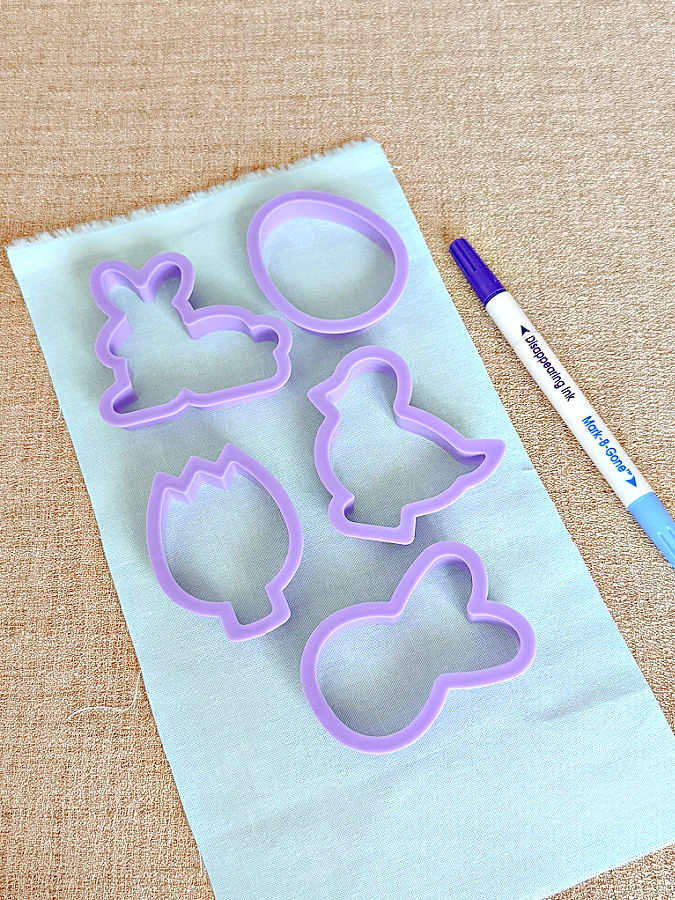
Cookie cutters are basically ready-made sewing templates that have been hiding in a kitchen drawer.
Stars, hearts, flowers, animals, Christmas trees—if you can cut a cookie with it, there is a good chance you can trace it onto fabric too.
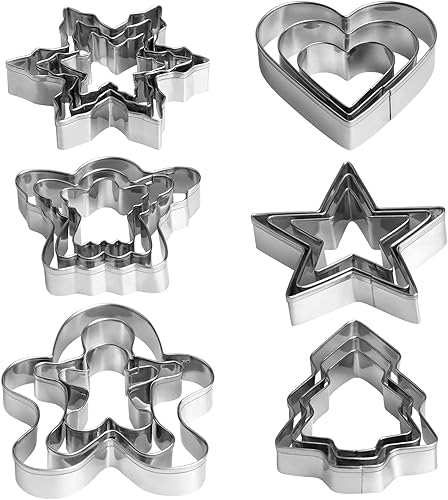

Use cookie cutters for:
- appliqué shapes
- felt ornaments
- embroidery designs
- quilting motifs
- fabric painting
- small decorations
- holiday sewing projects
Just trace around the outside and you have a perfectly recognizable shape without drawing anything yourself. This is especially useful for those of us whose hand-drawn star somehow ends up looking like a very tired potato 🥔.
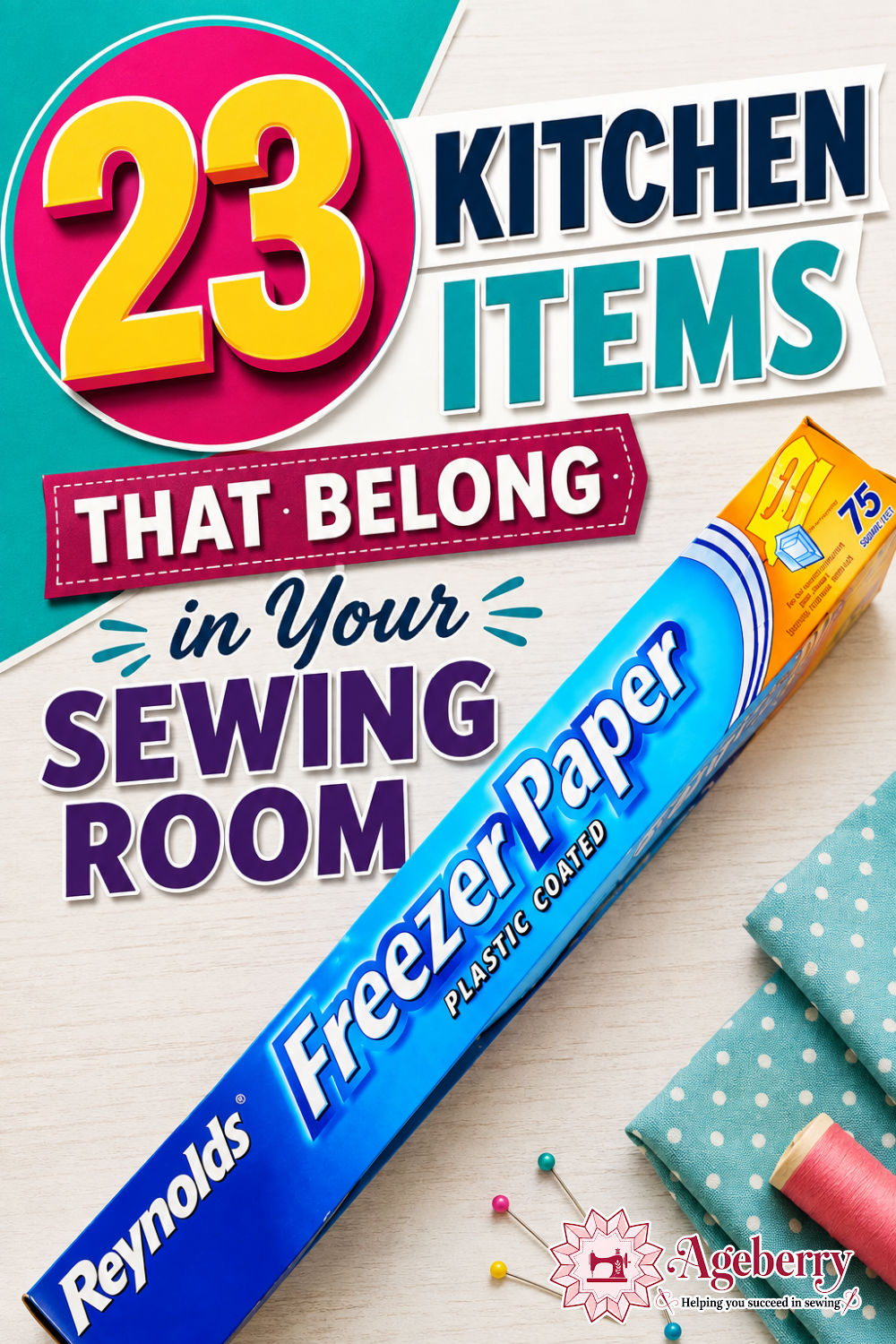
8. Freezer Paper
Freezer paper may live in the kitchen aisle, but sewists have been giving it completely different jobs for years.
The paper side is easy to draw on, while the plastic-coated side can temporarily stick to fabric when pressed with an iron. That combination makes it surprisingly useful for sewing and quilting.
You can use freezer paper for:
- appliqué templates
- tracing pattern pieces
- making reusable templates
- stabilizing fabric temporarily
- creating stencils for fabric painting
- some paper-piecing techniques
- preparing fabric for printing with an inkjet printer
And because it can usually be peeled away and used again several times, one little piece can have quite a productive sewing career.
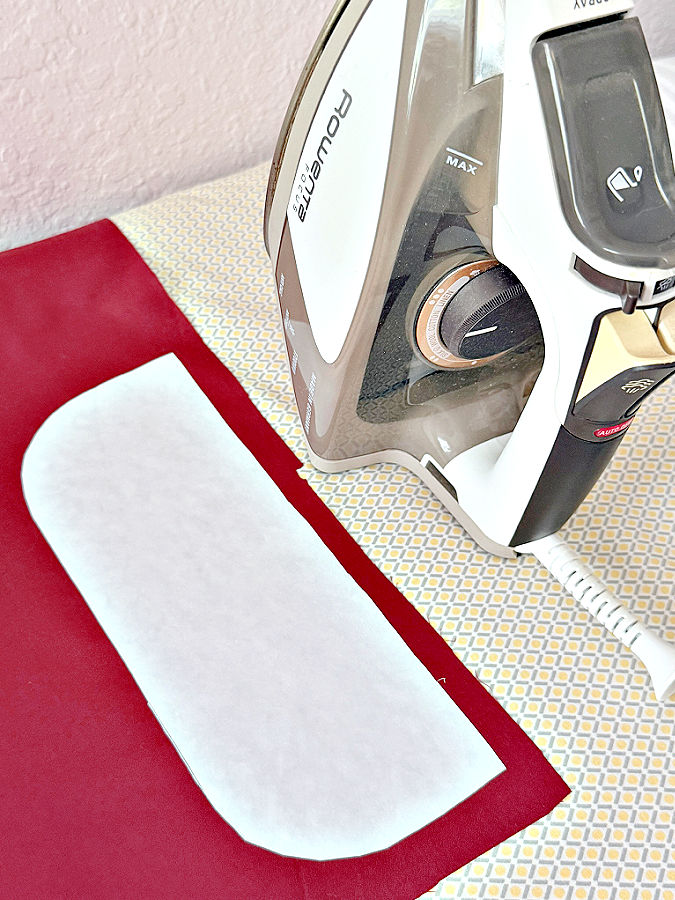
At this point, using freezer paper for food almost seems like wasting it.
I certainly didn’t know all these uses for freezer paper from the beginning. In fact, I once asked on my Facebook page, “How do you use freezer paper for sewing?” and the answers kept coming. People shared so many clever ways they use it for appliqué, quilting, printing on fabric, working with patterns, and more.
If you want even more ideas, take a look at the Facebook discussion here. There are plenty of good tips in the comments—and probably a few uses you haven’t thought of either.
9. Parchment Paper
Parchment paper is useful whenever sewing starts getting a little sticky.
I keep it in mind when working with fusible adhesives, fabric glue, paint, or anything else I would rather not permanently attach to my ironing board or sewing table.
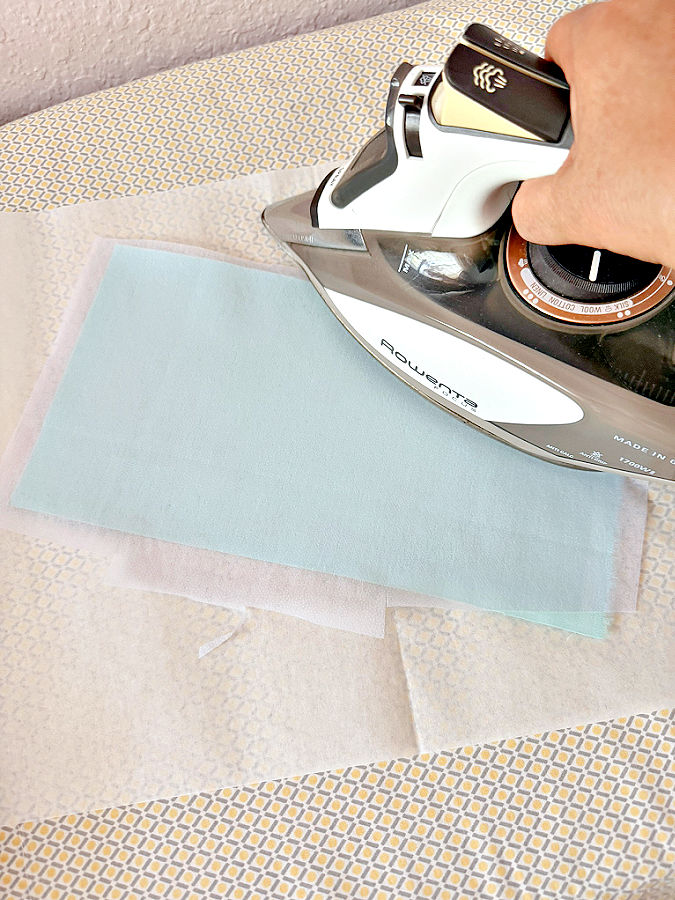
You can use parchment paper to:
- protect your ironing surface when working with fusibles
- keep adhesive away from the soleplate of your iron
- place underneath fabric-glue projects
- protect the table during fabric painting
- trace simple designs—the paper is translucent enough to see through
Much easier to throw away a messy piece of parchment than to spend the evening trying to remove glue from an ironing-board cover.
One important warning: parchment paper and wax paper are not the same thing. Don’t replace parchment with wax paper when heat is involved. Your sewing project does not need melted wax as an additional design feature.
10. Silicone Baking Mat
That silicone baking mat you bought with ambitious plans involving homemade cookies can have a useful career even if the cookies never happened.

A silicone mat makes a great protective work surface for messy sewing and craft jobs. Put it underneath:
- fabric glue
- hot glue
- adhesives
- fabric paint
- small pieces that tend to slide around
Many dried glues will peel right off silicone, which is considerably more pleasant than discovering that you’ve permanently glued your latest project to the sewing table.
The slightly grippy surface can also help keep little pieces from wandering while you work.
Just don’t turn it into a rotary cutting mat. Your rotary cutter and your silicone baking mat are happier when they maintain separate job descriptions.
11. Silicone Trivet
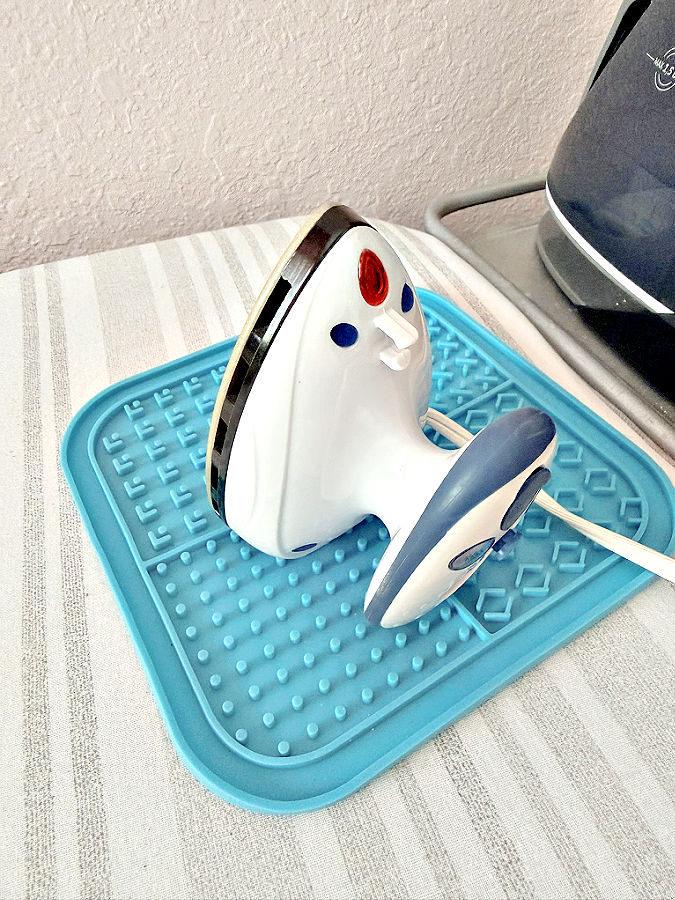
A silicone trivet is already designed to deal with hot things, so giving one a place next to your pressing station makes perfect sense.


It can provide a convenient resting spot for a:
- mini iron
- small craft iron
- hot appliqué tool
- other small heated sewing tool
Instead of wondering where to put the hot tool while you reposition fabric, you have a designated place ready for it.
12. Non-Slip Kitchen Shelf Liner
This may be one of the least glamorous things in the kitchen, but in the sewing room it can be ridiculously useful.
I’m talking about that rubbery, mesh-style shelf liner sold to keep dishes and glasses from sliding around.
Cut a piece and put it underneath a:
- sewing machine foot pedal
- serger foot pedal
- cutting board
- plastic templates
- small machine
- storage container
It adds grip without requiring you to permanently attach anything.
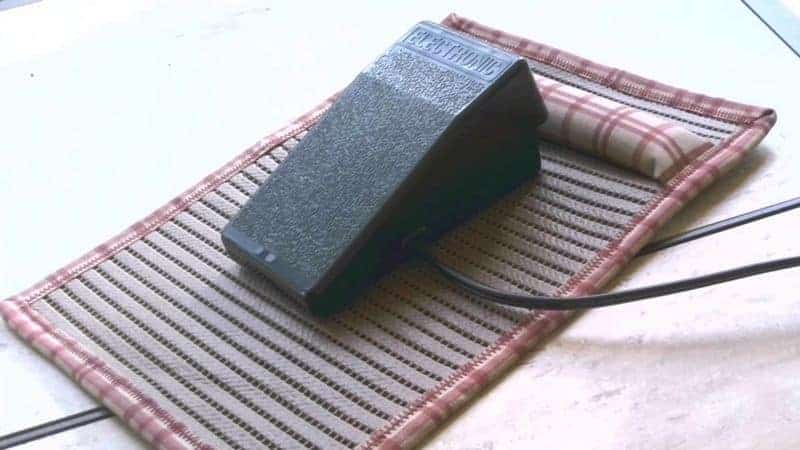
The foot pedal use alone may earn it permanent sewing-room citizenship. If your pedal slowly migrates farther and farther away while you sew, a small piece of shelf liner underneath can help keep it in place.
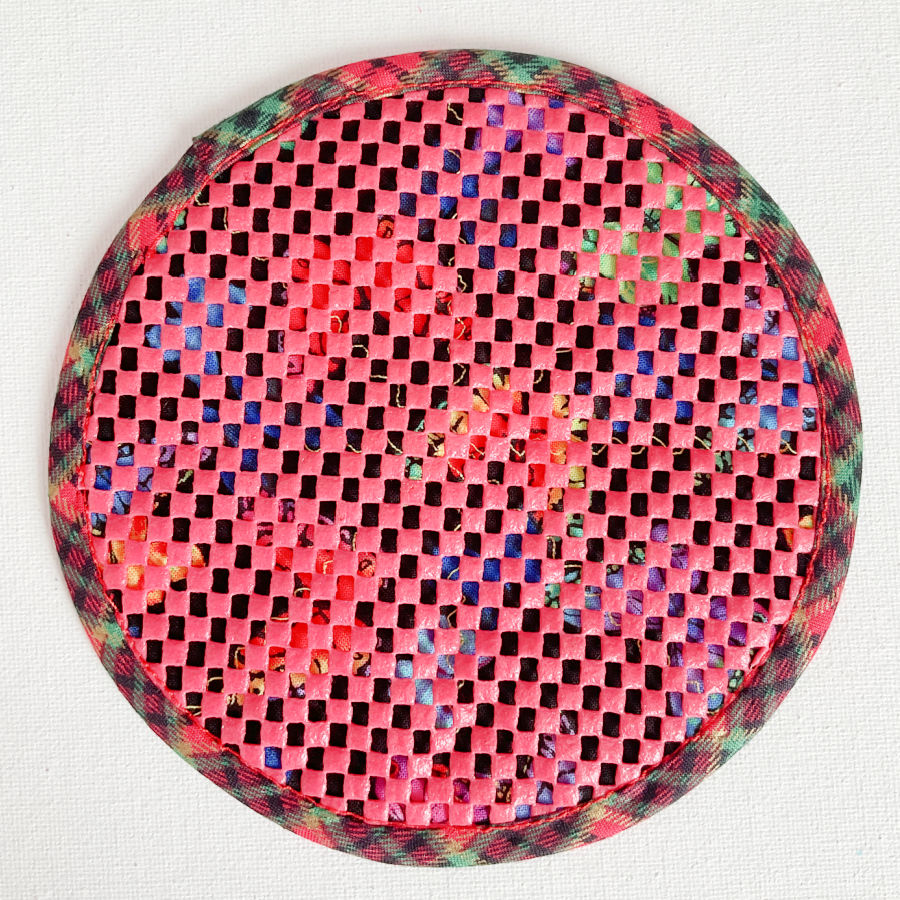
And I don’t use shelf liner only under things. I’ve also sewn it right into projects. I used it to make a DIY non-slip foot pedal pad and even a fabric jar opener. That grippy surface is surprisingly handy when you need something to stay put—or when a jar lid has decided to test your patience.
Apparently the shelf liner was meant to stop dinner plates from traveling around the cabinet. Mine has had a much more interesting career.
13. Kitchen Cutting Board
Your old kitchen cutting board can be useful in the sewing room—but not as a substitute for a rotary cutting mat.
Instead, use it as a protective work surface for the jobs that involve poking, pounding, punching, or hammering things.
A sturdy cutting board can go underneath your project when you are:
- installing snaps
- adding grommets or eyelets
- punching holes
- using an awl
- setting rivets
- hammering bag hardware
- working with some leather or vinyl hardware
It protects the table and gives you a small work surface that you can move wherever you need it.
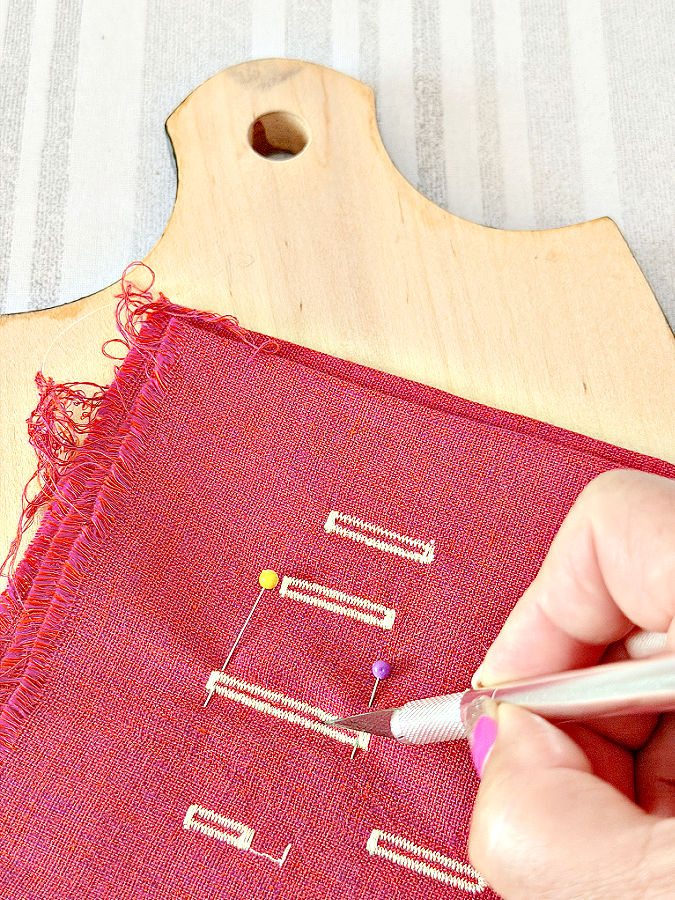
I would dedicate an old board to sewing rather than repeatedly moving one between the kitchen and sewing room. After you’ve hammered rivets on it, perhaps it has earned its retirement from chopping onions.
✅ Related tutorial: Buttonhole Basics and Beyond: Tools and Methods That Work
As a side note, I no longer use plastic or wooden boards in the kitchen. The plastic ones tend to shed minuscule bits of plastic and the wooden ones tend to hold organic material in pores and need frequent disinfection.
14. Canned Food
Next, a sewing tool you can buy in the soup aisle.
Unopened cans make surprisingly good pattern weights. They are heavy, stable, easy to grab, and most of us already have several sitting in the pantry.
Use them to hold down:
- large paper pattern pieces
- pattern paper while tracing
- fabric that wants to shift
- larger templates
They’re especially useful when you need substantial weight over a larger area. For tiny pattern pieces, a can of tomatoes may be a little excessive.
Just wipe the can clean before putting it on your fabric.
✅ Related tutorial: I started a 10-minute sewing project yesterday. I hope to finish it tomorrow.
15. Zip-Top Food Bags
For smaller sewing projects, zip-top bags may be very convenient.
They take almost no space, you can see through them, and you can write the project name directly on the bag.
Use them for:
- small pattern pieces
- embroidery supplies
- buttons
- elastic
- bias strips
- appliqué pieces
- leftover binding
- scraps you want to save
- presser feet or other accessories needed for a particular project
They are also useful when you cut out a project but aren’t going to sew it immediately. Put all those little pieces into one bag and they have a much better chance of still being there when you come back.
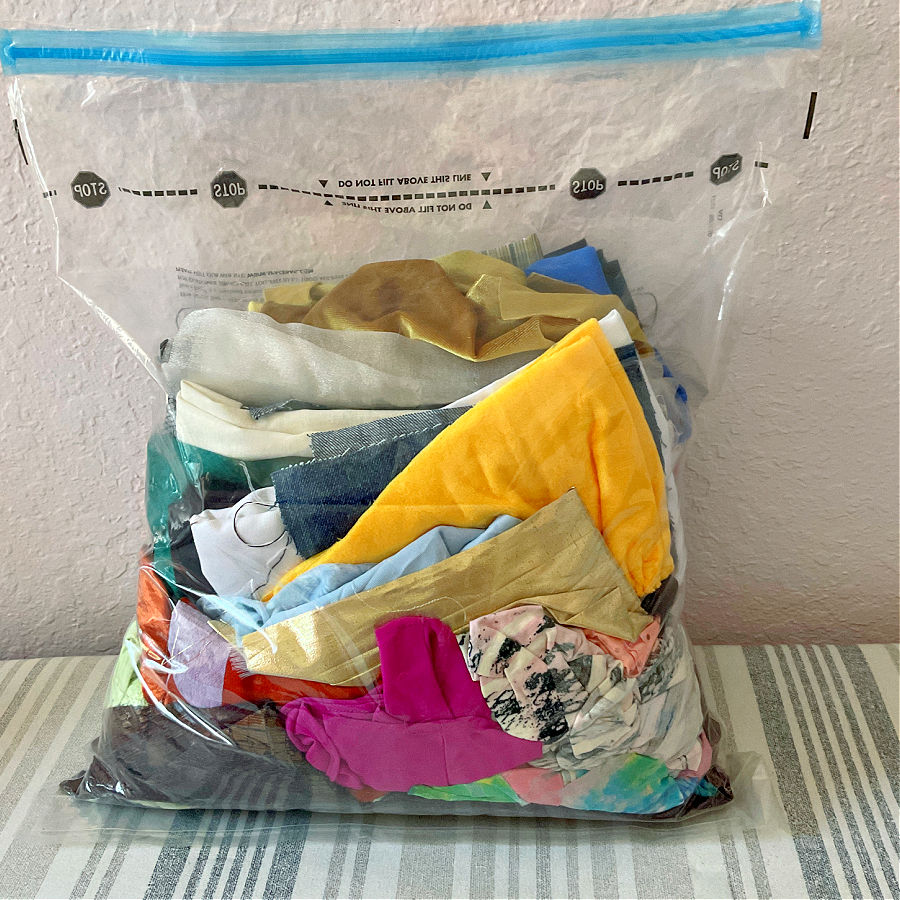
16. Ice Cube Trays
An ice cube tray is basically a notions organizer that someone accidentally decided to put in the freezer.
All those little compartments are perfect for separating:
- buttons
- snaps
- hooks and eyes
- beads
- safety pins
- bobbins
- eyelets
- tiny embellishments
- small sewing-machine parts
They are especially useful while you’re working on a project and want several small items within reach without mixing everything together.
Silicone ice cube trays are nice because you can flex the bottom to pop out tiny objects that would otherwise require fingernails, tweezers, and possibly some unpleasant language.
Just buy a separate tray for the sewing room.
17. Cutlery Tray
A cutlery tray doesn’t care whether it holds forks or seam rippers. It just wants things to stop rolling around in the drawer.
Those long compartments are almost perfectly shaped for sewing tools. Use them for:
- seam rippers
- fabric markers
- pencils
- small rulers
- rotary cutters
- point turners
- scissors
- seam gauges
- screwdrivers
- marking tools
Expandable cutlery trays are especially useful because you can adjust them to fit a wider sewing drawer and gain even more compartments.
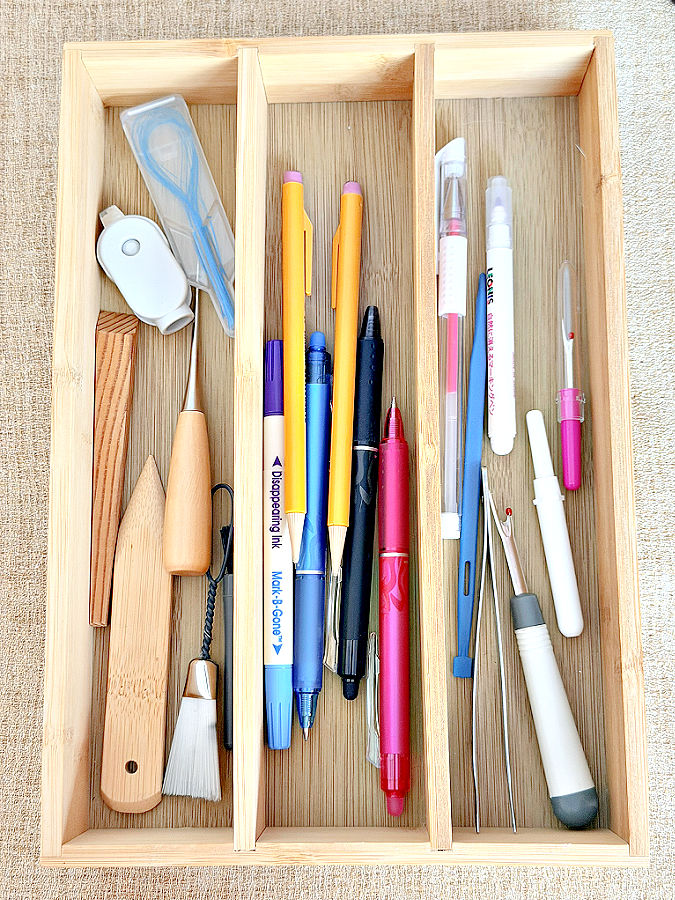
18. Lazy Susan
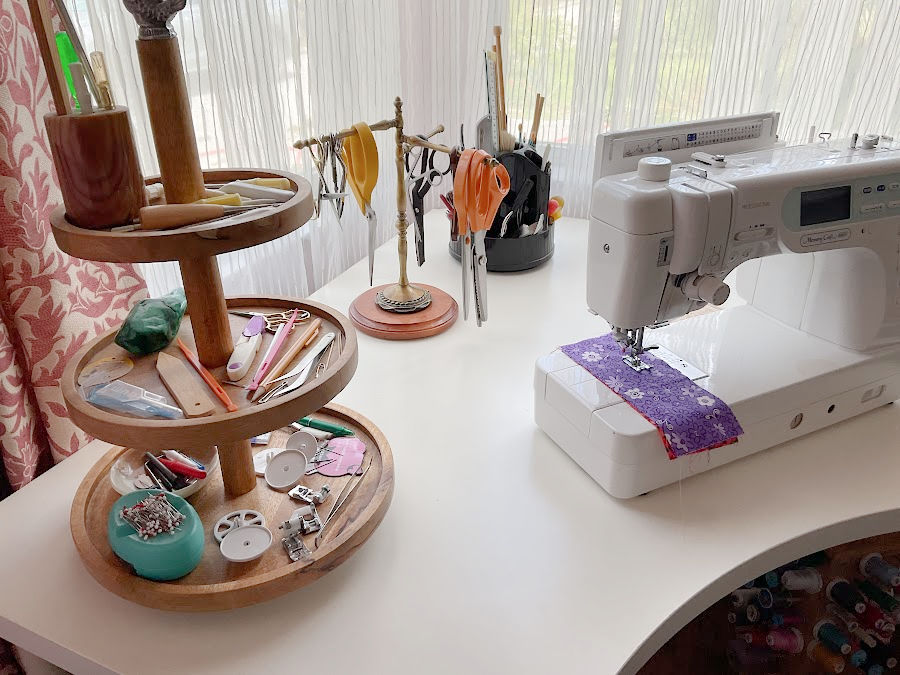
A Lazy Susan may be lazy by name, but she is willing to work surprisingly hard in the sewing room.

Put one on your sewing or cutting table and load it with the things you reach for constantly:
- scissors
- thread
- clips
- marking pens
- glue
- small rulers
- seam rippers
Then just spin it until the tool you need comes to you.
This is especially handy on a large cutting table where supplies always seem to end up approximately two inches farther away than your arm can reach.
Apparently, the solution was not longer arms. It was a rotating tray.
✅ Related tutorial: 25 Sewing Shortcuts That Make Sewing Easier and More Efficient
19. Paper Towel Holder
A paper towel holder already knows how to manage a roll, so there is no reason to limit its career to paper towels.
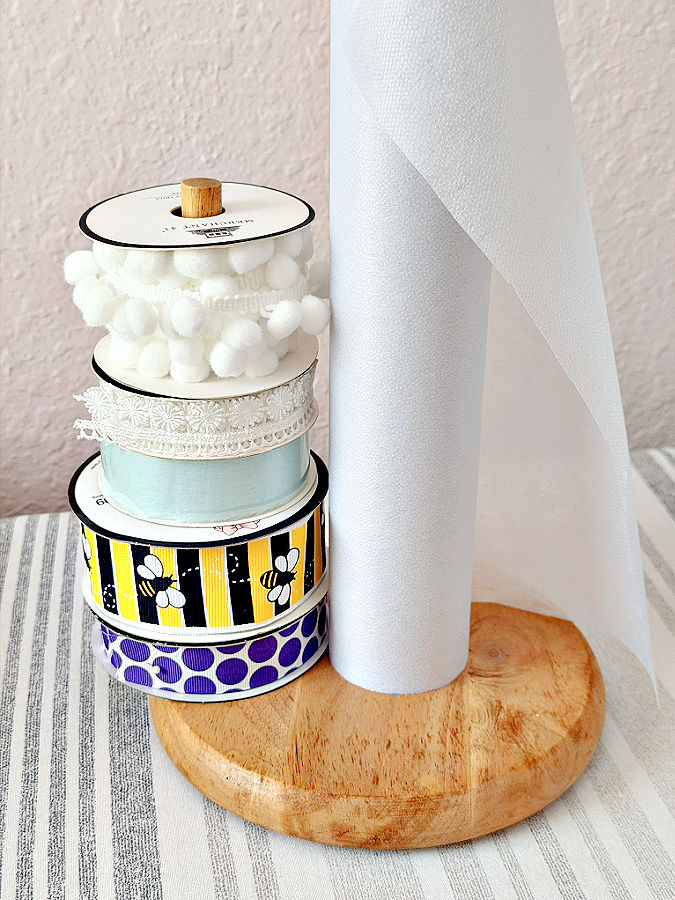
Depending on the style, a vertical or horizontal holder can store rolls of:
- ribbon
- elastic
- stabilizer
- interfacing strips
- pattern paper
- tracing paper
- vinyl
- transfer material
A horizontal holder can be especially convenient for ribbon or elastic because you may be able to pull off what you need without removing the whole roll.
20. Plate Rack or Pan Organizer
Those racks designed to keep plates, pans, and baking sheets standing upright can solve another problem: where to put all those flat sewing things that don’t stack nicely.
Use the slots for:
- quilting rulers
- small cutting mats
- pressing mats
- pattern templates
- embroidery hoops
Everything stays upright, separated, and much easier to grab.
This is particularly useful for acrylic rulers. Stack enough of those flat in a drawer and somehow the exact ruler you need will always be at the bottom.
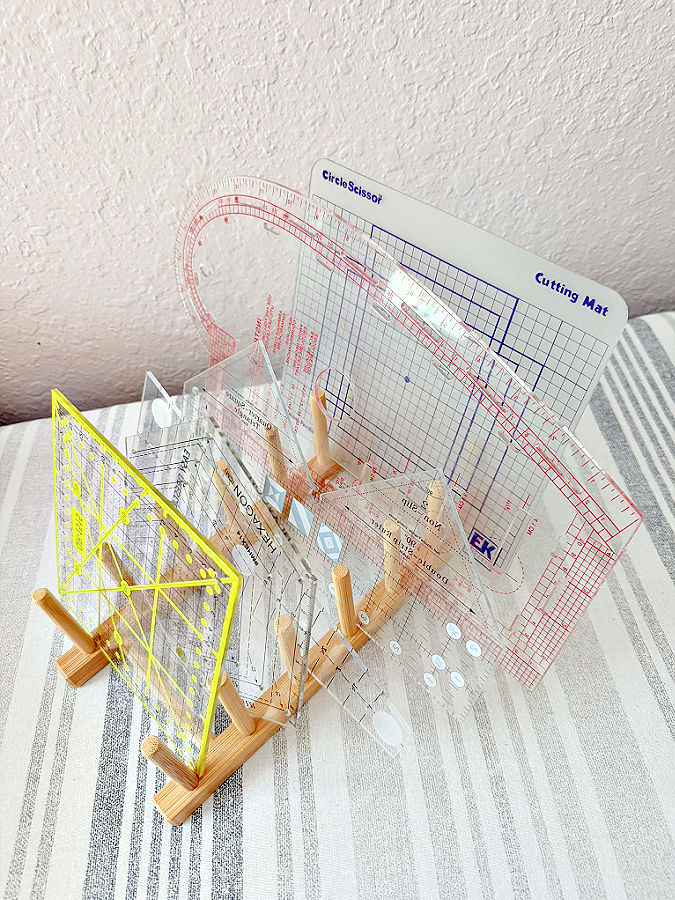
A pan organizer puts an end to that little tradition.
21. Napkin Holder
A napkin holder is another ready-made organizer hiding in plain sight.
Set one beside your sewing machine and use it for the papers and flat supplies connected with your current project:
- pattern instructions
- small pattern pieces
- templates
- small rulers
- appliqué sheets
- stabilizer pieces
- notes and measurements
It keeps everything upright and visible instead of underneath the fabric, underneath the pattern, underneath the scissors, underneath…well, everything else on the table.
And because it takes up very little space, it works well even if your sewing table has reached the stage where every square inch has already been assigned a job.
22. Wine Rack
If a wine rack can keep bottles neatly separated, it can certainly handle a few rolls of stabilizer.
Depending on the size and shape of the rack, those individual openings can hold rolls of:
- stabilizer
- interfacing
- vinyl
- cork fabric
- pattern paper
- tracing paper
- rolled fabric remnants
A small tabletop wine rack could work beside a cutting table, while a larger one could become dedicated storage for materials you buy on rolls.
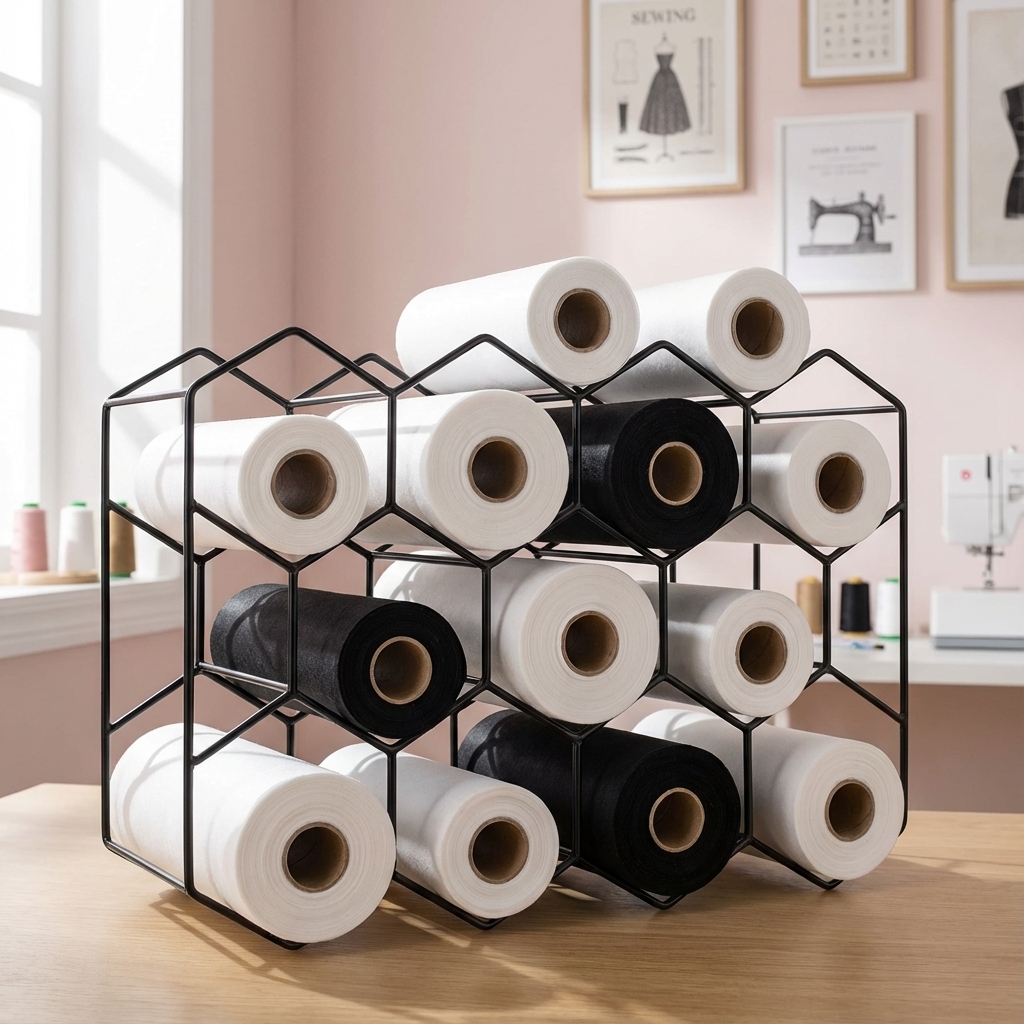
Of course, this does require explaining why the wine rack now contains interfacing instead of wine.
I suppose every hobby has sacrifices.
✅ Related tutorial: Interfacing vs Stabilizer: Is There Really a Difference?
23. Refrigerator Magnets
Refrigerator magnets don’t have to spend their entire lives holding grocery lists and takeout menus.
Move a few into the sewing room and use them with a magnetic board to hold:
- pattern instructions
- small paper pattern pieces
- sewing notes
- embroidery designs
- appliqué templates
- reference charts
- project diagrams
This is especially handy when you need instructions where you can see them while sewing instead of repeatedly digging them out from underneath the fabric.
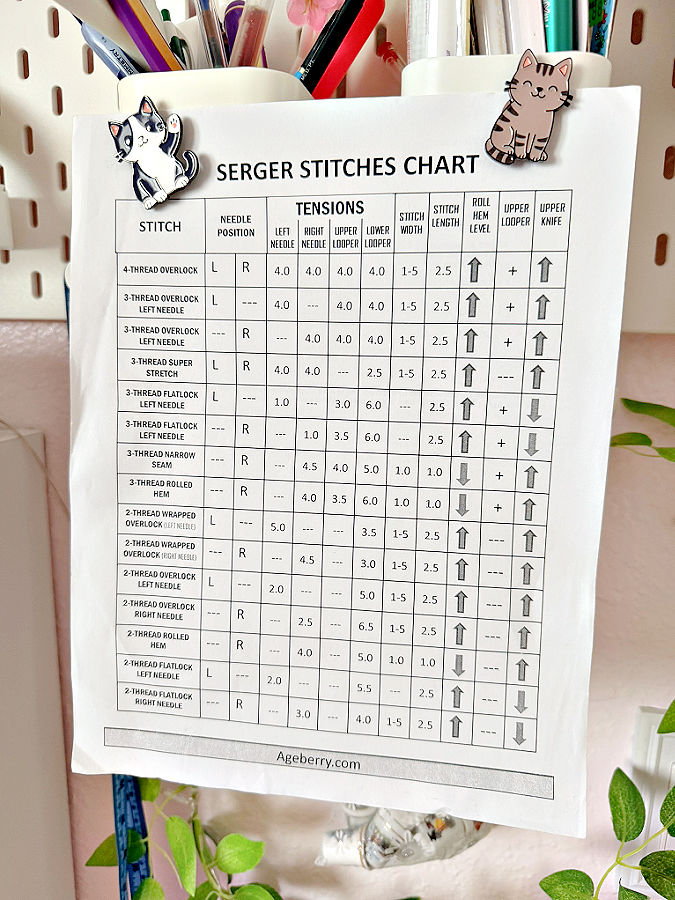

That’s my current list of kitchen items with a second job in the sewing room. If any of these end up on your sewing table too, I’d love to hear which one becomes your favorite.
And if you have ever wondered what other items already in your kitchen can be also used in a sewing room, please let me know what else you found – this way, we all learn!
Did you ever use, or think of using regular kitchen items in your sewing room? If so, save this pin (see below) on your sewing board and follow me on Pinterest for more tips, tutorials, and inspiration!

latest posts
- 10 Easy-to-Miss Features on Sewing Supplies You Should Be Using
- Twin Needle Sewing: My First Try Was a Mess, But Here’s What Worked
- 10 Rules That Made Me a Better Sewist
- How to Make a Lightweight Summer Neck Scarf with a Lettuce Hem
- What Sewists Hate About Sewing: Common Complaints and Practical Fixes
- Knit Presser Foot: How It Works, How to Use It, and My Sewing Tests
- How to Sew Neat Mitered Corners at Acute Angles
- Sewing Machine Needle Organization: A Clever System I Tried
- DIY Car Armrest Organizer: Sewing Tutorial
Dear Olga, Thank you for this reminder of handy kitchen sewing tools. I have been unable to sew for a few years, but I think the only kitchen tool I did *not* use was the wine rack! And I used a single layer lazy Susan to hold needed items when several students needed to work together-just turn the Susan to get the tool you need. (Use this for wrapping Xmas presents, too, to change the orientation of the scotch tape easily; this worked well for cooperative wrapping projects as well!)
Thank you! I believe most of us have used at least some of the tools described here at some point or other. But I think having them gathered under one article may be useful as a reference.