What Do You Call a Person Who Sews? I Asked My Readers and Got 1,408 Opinions
Let me tell you about the problem that has followed me around since I started this site (Ageberry).
I sew. I love to sew. I sew in the morning before the rest of the house wakes up. I sew late at night when I really should be sleeping. I have fabric in places where fabric probably shouldn’t be. I plan vacations around fabric stores in cities I’ve never visited. Sewing is not just something I do — it’s a big part of who I am.
So you’d think there would be a simple, clean, obvious word to describe me.
And there is not. Or rather — there are too many, and none of them are quite right, and people have feelings about this, and those feelings are surprisingly intense.
Let me start at the beginning.
Why I Refuse to Call Myself a Sewer
The first problem is the most obvious one. The most grammatically straightforward word for a person who sews is… sewer.
No.
Absolutely not.
Any second thoughts? I’m sorry, but no.
English can be a little strange, especially for those of us who did not grow up with all its little tricks and traps. Calling a person who sews a sewer feels a bit like calling a person who draws a drawer.
Go ahead, open Google right now and type in “sewer.” The very first definition that comes up is:
“an underground conduit for carrying off drainage water and waste matter.”
Now, yes, technically the pronunciation is different — SEW-er versus SOO-er. But I have spent real energy in my life avoiding sentences like “I am a sewer” because they make people tilt their heads at me in a way I do not enjoy. And honestly, even if everyone in the room knows what I mean, something about it just doesn’t sit right.
There’s no dignity in it. I didn’t spend three hours matching plaids on a jacket so I could be described the same way as a drainage pipe.
It also reminds me of something I once read: in American English, we drive on a parkway and park on a driveway. The language is already doing its best to confuse everyone. I am not going to help it along.
So. Not sewer. I refuse to introduce myself as something that also carries waste water. Moving on.
The Other Options Don’t Make It Easy Either
Okay, so sewer is out. What else do we have?
Seamstress Sounds Pretty, But It Does Not Fit Everyone
Seamstress. Lovely word. Has history. Has elegance. But the dictionary definition is
“a woman who sews, especially one who earns her living by sewing.”
Two immediate problems. First — in the sewing world, men sew too, and they deserve a word that doesn’t feel like a polite afterthought. Second — I am mostly spending money when I sew, not earning it. Calling myself a seamstress feels like an aspirational lie.
Some people sew for business. Some sew for the family. Some sew because fabric stores are cheaper than therapy, though not by as much as we tell ourselves.
So seamstress works in some cases, but it does not cover the whole sewing room.
Tailoress Had a Chance, But Not a Very Big One
Tailoress. A tailoress is “a woman whose occupation is making fitted clothes such as suits, pants, and jackets to fit individual customers.” Which is a perfectly fine thing to be, but I also sew home décor, purses, quilts, and approximately one million tote bags I don’t need. Tailoress doesn’t quite cover the full chaotic range of my sewing life.
What About Tailor?
Tailor. More gender-neutral in practice, but still carries that very specific image of a man in a waistcoat with a measuring tape around his neck. Not exactly what comes to mind when I’m cutting fabric for throw pillow covers at 10PM on a Tuesday. Or when I am quilting a placemat.
A tailor usually makes or alters fitted garments, especially clothes such as suits, jackets, trousers, and coats.
It is a respected word. It has skill built into it. But not every person who sews is a tailor. If I make a potholder, a pillowcase or an Easter basket holder, I would feel odd if I called myself a tailor.
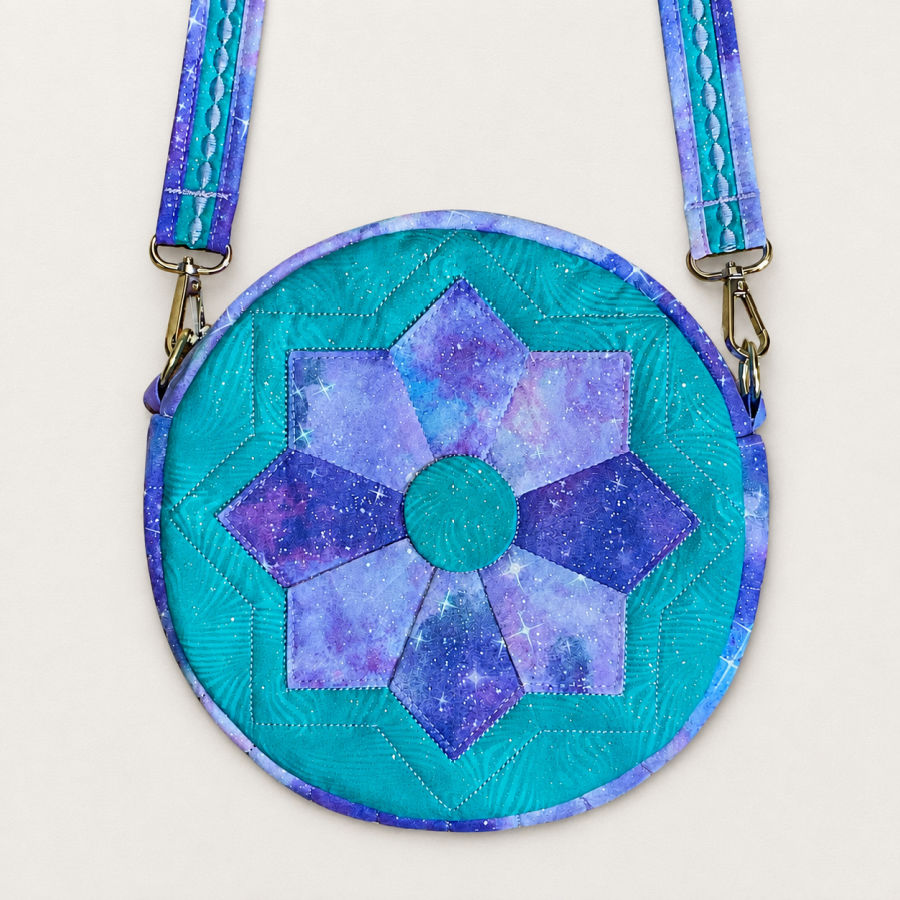
By the way, would a tailor make a purse? I did! DIY Round Purse.
A tailor knows how to shape garments to a body with precision. That is its own craft. Sewing is broader. It can include tailoring, but it does not stop there.
Then There Is Sewist
So there I was, in the early days of this site, genuinely not knowing what word to use when I referred to myself or my readers. I tried to dodge it as much as possible — which, if you write about sewing, is a little like trying to write about cooking while avoiding the word food. It gets exhausting.
That’s when I started getting creative.
Fabricologist? Has a certain scientific ring to it. Like I’m in a lab studying the tensile strength of cotton blends. I could wear a white coat.
Materialist? This one made me laugh for about twenty seconds. I realized it means something else entirely and would be very confusing in a sentence.
I was clearly grasping at threads (pun fully intended). And then I came across the word sewist — and it clicked. It made sense. It felt right. I started using it, even though my spell checker underlined it in red.
It is short, clear, and general.
It does not tell us the person’s gender. It does not say the person earns money from sewing. It does not limit the person to clothing. It can include people who sew quilts, garments, bags, crafts, home decor, and handmade gifts.
It simply means a person who sews.
Some spell checkers still glare at it with a red underline. But spell checkers are not the boss of language. Mine still has trust issues with perfectly normal sewing terms.
Try typing understitching, staystitching, serger, or armscye into some programs. The computer acts as if you dropped a button into its soup.
A red underline does not always mean a word is wrong. Sometimes it means the software needs to spend more time in a sewing room.
And Then Came the Facebook Comment
I thought I was quietly minding my own business, using my made-up-ish word in peace. And then this appeared in my Facebook comments:
“Why do people call someone who sews a ‘sewist’??? NO such word. A woman who sews is a Seamstress, or sewer. A man is a Tailor — all taught in 4th grade English. It’s not ‘fancy’ OR correct English, just like a person who collects honey is an apiarist, or a person who treats animals is a Vet. SO stop putting ‘IST’ on the end of a word! It just shows YOUR ignorance!”
Well. That comment came with pins out. Let’s take a breath.
I want to say, first of all, that I genuinely appreciate passion about language. Words matter. Etymology is fascinating. And this person clearly cares deeply about the English language, which I respect.
But. Sewer??? Doesn’t smell right.
My response was this:
“Language changes all the time. ‘Sewist’ may not be everyone’s favorite word, but many people use it now because it feels more general than seamstress or tailor. And ‘-ist’ is not unusual at all — artist, florist, pianist, dentist, scientist, cyclist, violinist, specialist… many words end that way. Some of those words were created a long time ago, but they were still created by people. If people could make new words 200 years ago, I think we can still make new words now.” 😊
Because here’s the thing — every word was made up by someone, at some point.
Yes, the language is changing. Want some proof of recent changes? Do you know the history of the term “software engineering”? It was “invented” in the 1960s and in itself contains a term added to the language sometimes during the 20th century. And yes, it was created by a remarkable woman scientist: History of software engineering – Wikipedia.
“Scientist” wasn’t carved into a stone tablet by a higher power. A person sat down and said, “we need a word for this” and invented one, and eventually enough people used it that it stuck. That’s how language works. That’s how it has always worked. The dictionary is not a museum of ancient truths — it’s a living record of what people actually say.
“Sewist” follows perfectly logical English word-formation patterns. We have art → artist, cycle → cyclist, piano → pianist, special → specialist. So sew → sewist makes complete sense. It’s not ignorance. It’s grammar, doing its normal thing.And yes, sewist is not just a word people invented in a sewing group last Tuesday. It appears in modern dictionaries, including Collins:
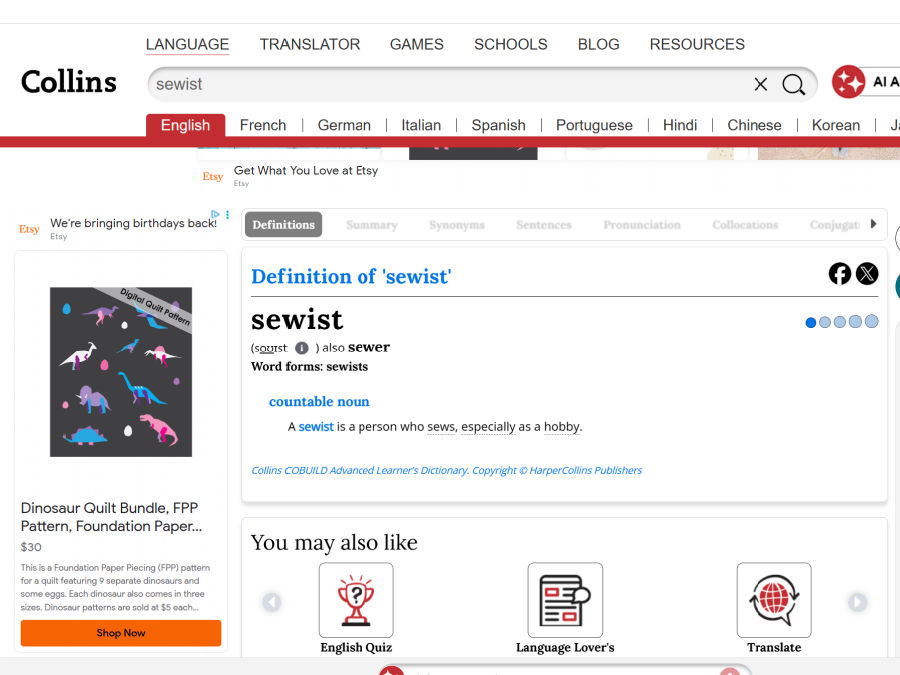
It is also listed in Oxford’s dictionary records, here it is. So the word has moved beyond sewing-room slang and the spell checker can calm down.
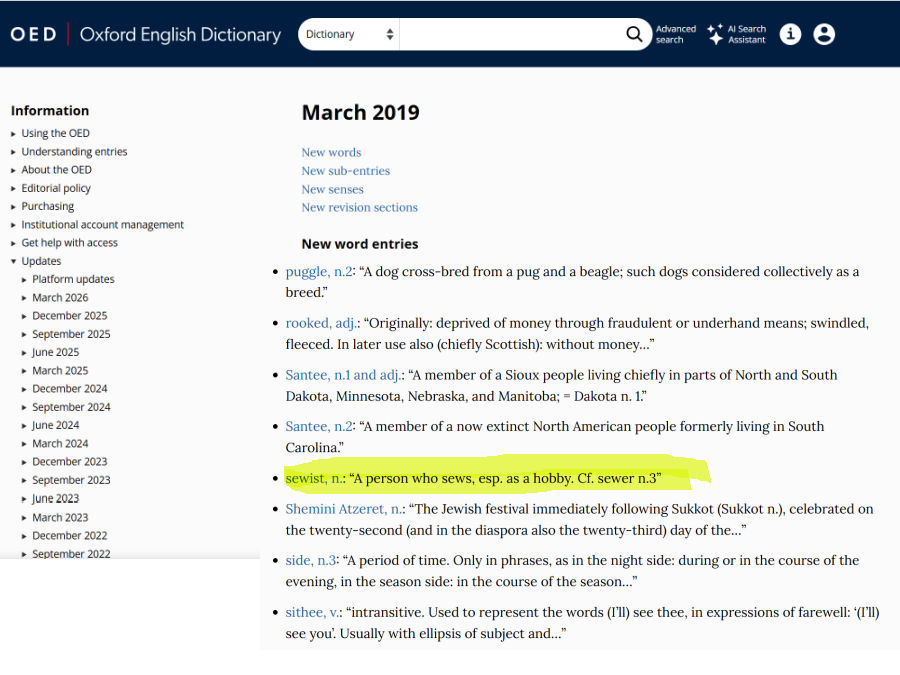
And in case anyone’s still skeptical — “sewist” is widely used across sewing communities around the world, discussed in major sewing publications, and recognized by anyone who has picked up a rotary cutter in the last decade. Is it in Merriam-Webster yet? No. But neither was “selfie” once upon a time. Give it a moment.
A Small Confession
Now would be a good time to mention something I perhaps should have led with.
Before I had this Ageberry sewing site. Before I moved to the United States. Before I became a person who buys fabric in quantities that concern my family — I was a university professor. Teaching linguistics.
Yes. That kind of linguistics. The academic kind.
Also the kind where you know the history of word formation, understand morphological derivation, can explain exactly why adding “-ist” to a root is not only acceptable but follows centuries of documented English word-building patterns, and have actually written dictionaries and papers about the way language — not English, mind you, a whole other language — evolves through community usage.
So when someone tells me that “sewist” is ignorant English — I am, how shall I put it — professionally equipped to disagree.
I didn’t bring this up earlier because honestly, it felt a little like showing up to a neighborhood dispute and quietly mentioning you’re a judge. But here we are. The irony of a former linguistics professor spending a decade agonizing over what to call a person with a sewing machine is not lost on me. I analyzed the structure of entire languages. I stood in front of lecture halls and explained how words are born, how they travel, how they change meaning across generations.
And then I moved countries, picked up a rotary cutter, and could not for the life of me figure out what to call myself.
Turns out, knowing everything about language does not make the language easier. It just means you lose the argument more thoroughly when your spell checker wins.
I Put It to a Vote — And You Showed Up
Back in 2017, before the Facebook comment, before the dictionary recognition, I decided to do what any reasonable person does when they can’t make up their mind: I asked the readers.
I put a poll on my About me page with the options I could think of — Sewist, Seamstress, Tailoress, Sewing Enthusiast, Stitcher, Sewpreneur — plus a write-your-own option for those of you with better ideas than me.
1,408 people voted.
Over nearly a decade, people kept finding that poll and having opinions about it, and I love every single one of you for that. Here’s what happened:
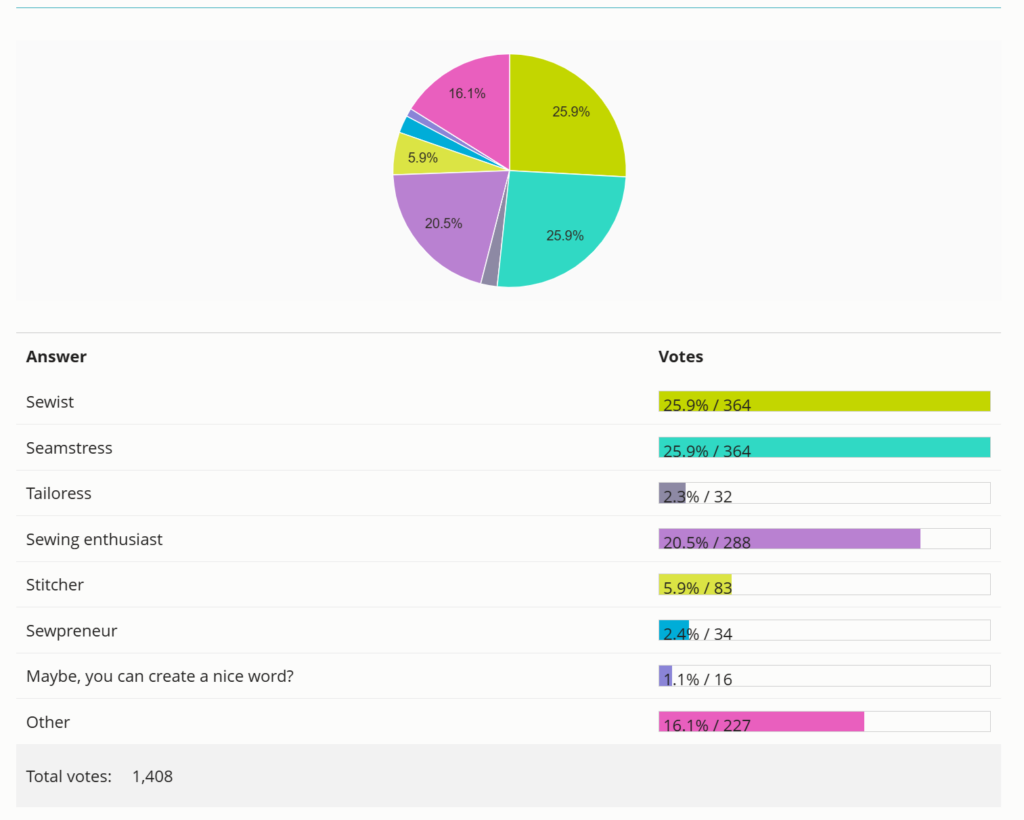
I want you to really look at that top of the table for a moment.
Sewist: 364 votes. Seamstress: 364 votes. Identical. An exact tie. Out of 1,408 votes, across nearly nine years, these two words landed on the same number down to the single vote. If I had staged this, nobody would believe me. The universe is funny.
“Sewing enthusiast” came in at a very respectable third with 20.5% — and honestly, this is a solid choice. It’s warm, inclusive, works for every gender, and doesn’t require anyone to know what an underground conduit is. “Sewing enthusiast” is the diplomatic option: everyone can agree on it and nobody gets offended.
But it is a bit long. Imagine using it several times in one tutorial.
“The sewing enthusiast should press the seam. Then the sewing enthusiast should trim the corners. Next, the sewing enthusiast should turn the piece right side out.”
By the end of the paragraph, the reader may need coffee and she/he would no longer feel enthusiastic about the article.
And then there was the Other category. 227 people — 16.1% of voters — looked at all my carefully prepared options and said: “none of these will do.” This is the part of the results I probably treasure most.
The “Other” Answers: A Journey
The “Other” box in the poll turned out to be a little treasure chest. Some readers were practical. Some were serious. Some clearly saw the question and decided this was their moment.
I’m going to share some of the write-in submissions, because you deserve to read them.
This answer caught my eye:
I call you Sewlga, but otherwise sewing … savant, guru, expert, wizard, enthusiast, or as you like at the time.
Now, Sewlga made me laugh. It is personal, silly, and very specific. I may not be able to use it for everyone, because not every person who sews is named Olga. Very inconvenient, I know. But I admire the creativity.
The rest of that answer also shows why this question is harder than it seems. Sewing savant sounds impressive, though it may be too much pressure for a Tuesday afternoon with a crooked zipper. And a “savant” does not use swear words when using the seam ripper. Sewing guru has a nice ring to it, but I do not want anyone to think I sit beside my sewing machine with ancient wisdom and perfectly wound bobbins.
Sewing wizard might be my favorite from that list. Sewing does feel a bit magical at times. You start with flat fabric, a paper pattern, thread, and a plan. A few hours later, you have a dress, a quilt block, a bag, or a sleeve (that somehow ended up inside out, ha-ha). Magic, yes. But the kind of magic that also requires a seam ripper.
Another reader suggested this:
Needle woman according to the Macmillan dictionary. It makes you feel like a pincushion doesn’t it?
That one made me laugh too, because it is hard not to picture a person covered in pins from shoulder to hem. Needlewoman is a real word, and it does have a certain historical charm. It sounds like someone who sits by a window with perfect posture, a silver thimble, and not one thread tail on the floor.
Needlewoman feels connected to generations of women who sewed before us: mothers, grandmothers, and all the patient people who kept families clothed before online shopping made us believe everything should arrive in two days.
Still, I am not sure I want to call myself a needlewoman.
The ones that are genuinely excellent and I might start using:
- Sewcialist — perfect. Political undertones. Strong branding.
- Stitchinista — fashionable. Has energy.
- Virtuosew — someone submitted this and I applaud them. That is a pun AND a compliment in one word.
- Stitch witch — for those of us who do our best work late at night with a slightly unhinged look in our eyes.
- Sewsiopath — specifically for the person who has started seven projects this month and finished zero. We see you. We ARE you.
- Sewcialist (yes, I’m listing it twice because it deserves it – ha-ha)
- Fabricaholic
- Sewaholic
- The Sewinator
- Sewologist / Sewoligist (submitted twice, with different spellings, which adds to its charm)
The ones that are unhinged in the best way:
- Queen of the Universe — submitted April 2024. No context. No explanation. Just vibes. This person is thriving. I will discuss this with my husband; I like it.
- Supreme goddess of the sewing room — equally thriving. But also obvious.
- Saint — accurate, frankly, given how much patience sewing requires.
- Genius! — the exclamation point really makes this.
- My kids call me awesome. — I want this on a tote bag. On a t-shirt. On a pillow.
- A fashion Goddess. love you site — this person voted, paid me a compliment, and left. A complete transaction. I respect it.
- Sewberry Awesome — I see you, I love you, thank you.
The ones that are honest and relatable:
- I don’t have a suggestion but feel the same way! — thank you for your solidarity.
- You are right, there is no adequate word. Will continue to think on it. — still thinking, probably.
- I just say “I sew” and don’t worry about the ending. — the most Zen response in the entire dataset.
And last but not least:
TOO MUCH ADVERTISING ON YOUR WEBSITE!!! AAARRRGGGHHH!!! — submitted April 2022.
Not quite what I asked. But feedback received. Unfortunately, unavoidable if I want to keep publishing.
Oh — and one person voted for Fabricologist. My joke suggestion from years ago. My ridiculous word that I threw out as a bit of fun. Someone out there is identifying as a fabricologist and I fully, wholeheartedly support their journey. And yes, one needs to know a lot about fabric when sewing, I have written myself many articles on that subject.
Related articles:
- What Sewing Lessons Don’t Tell You About Fabric — But Should
- Fabric Types Made Simple: Woven, Knit, Non-Woven Explained
- All About Sewing Knit Fabric
One funny thing I noticed in the poll results is that almost nobody rushed in to defend sewer. A few readers did write it in under “Other,” and one person even said, “Sewer! I don’t have a problem with it at all!” So the word is not completely friendless.
But it certainly did not win the popularity contest and stayed near the bottom of the sewing basket.
That tells me something. Many of us know sewer is a valid word for a person who sews. We also know our brains still see that spelling and take a sharp left turn toward drainage pipes. A word can be correct and still feel awkward. Sewing is full of precise language, but this may be one place where the dictionary and the sewing room politely disagree.
So What Did We Learn?
After 1,408 votes, years of comments, a Facebook debate, and more creativity than I honestly expected from a poll about nouns — here is where things stand.
Sewist is no longer just an internet word. It’s in the dictionaries. It’s gender-neutral, logical, and used widely across sewing communities. The spell checker still puts a red line under it sometimes, but you can right-click and teach it — and I think, making your spell checker learn a new word feels a little poetic given this whole discussion.
Seamstress has stood the test of time for a reason — it’s beautiful and recognizable — but it carries built-in assumptions about gender and profession that don’t always fit our modern, wonderfully mixed-up sewing world.
Sewing enthusiast is the safe harbor. Warm, inclusive, self-explanatory. Not very glamorous, but it never causes confusion.
And the write-ins? The fabric artists, textile artists, stitch witches, and sewcialists? They tell a richer story than any single word can. The sewing community is too creative, too diverse, and frankly too funny to be reduced to one label. We make things with our hands. We rip seams and start over. We buy fabric at midnight. We are, apparently, Queens of the Universe, Sewsiopaths, and Sewberry Awesome all at once.
Yes, sewist is a real word in common use.
That does not mean every person must use it.
Language is not a sewing pattern where only one cutting line is correct. Words have history, tone, and personal preference. Some people love sewist. Some dislike it. Some prefer seamstress because it feels familiar. Some use stitcher because it feels simple.
The useful question is, “Does this word help people understand what I mean?”For me, sewist does that job.
Maybe that’s the real answer. Maybe we don’t need one perfect word. Maybe the fact that we’re still arguing about it — with this much wit, this much warmth, and this much enthusiasm for puns — says everything that needs to be said about who we are.
We are people who sew.
And my kids call me awesome.
Did you find this article a little bit entertaining? Does it inspire to add your vote to the poll? If so, save this pin (see below) on your sewing board so you can come to this tutorial later when you are ready, and follow me on Pinterest for more tips, tutorials, and inspiration!

latest posts
- Sewing Thread Secrets: 8 Tiny Details You Probably Never Noticed — But Should
- Bias Tape Tutorial: How to Make Bias Tape With a Bias Tape Maker
- 10 Easy-to-Miss Features on Sewing Supplies You Should Be Using
- Twin Needle Sewing: My First Try Was a Mess, But Here’s What Worked
- 10 Rules That Made Me a Better Sewist
- How to Make a Lightweight Summer Neck Scarf with a Lettuce Hem
- What Sewists Hate About Sewing: Common Complaints and Practical Fixes
- Knit Presser Foot: How It Works, How to Use It, and My Sewing Tests
- How to Sew Neat Mitered Corners at Acute Angles
…if it makes you feel better about the fussy person, the earliest recorded use of the word “sewist” (that can currently be found as far as I’m aware) comes from an article in the New Orleans Times-Democrat…from 1868. There’s also an article in Threads Magazine from 2022 that references a bit more of the history of the word which may be interesting to you. Depends on your level of sewing nerd.
Sincerely,
Your fellow sewist and English enthusiast 😉
Thank you! I did not really look for the earliest use of the word; perhaps I should have.
What a fun article! My son and I quite enjoy vigorous debates over evolving language. As to the subject at hand, what do I call myself as a person who sews garments, quilts, does slipcovers as well as upholstery, makes totes and random things like bags for sails, airplane wings, or is the crazy mom who helps her son construct a coracle? I call myself a maker. I make things. Although I have to admit the term covers things that don’t necessarily involve needles, thread or fabric. Still, it’s the best descriptor that covers all of the things that I do.